


















-
 +16 +1
Researchers find key to keep working memory working
Yale researchers’ discovery of a key molecule in the brain could lead to potential treatments for neurocognitive disorders like schizophrenia and Alzheimer’s.
-
 +19 +1
The Strange Link Between Pandemics and Psychosis
Scientists are looking more closely at how viruses and infections could influence our minds.
-
 +9 +1
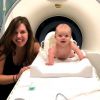
+9 +1Earliest look at newborns' visual cortex reveals the minds babies are born with
Within hours of birth, a baby’s gaze is drawn to faces. Now, brain scans of newborns reveal the neurobiology underlying this behavior, showing that as young as six days a baby’s brain appears hardwired for the specialized tasks of seeing faces and seeing places.
-
 +18 +1
Why are we getting smarter? Further reading on the “Flynn effect”
In the 1980s, psychologist James Flynn discovered that, over the past century, our average IQ has increased dramatically.
-
 +3 +1
+3 +1Do We Have Minds of Our Own?
The strange, startling, and competing explanations for human—and possibly nonhuman—consciousness.
-
 +2 +1
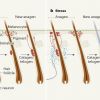
+2 +1How the stress of fight or flight turns hair white
Signalling from the sympathetic nervous system of mice when subjected to stress leads to the depletion of a stem-cell population in their hair follicles. This discovery sheds light on why stress turns hair prematurely grey.
-
 +2 +1
+2 +1Are We “Brain Washed” during Sleep?
A new study from Boston University is the first to illustrate that the brain’s cerebrospinal fluid pulses during sleep, and that these motions are closely tied with brain wave activity and blood flow. It may confirm the hypothesis that CSF flow and slow-wave activity both help flush toxic, memory-impairing proteins from the brain.
-
 +16 +1
Eight weeks to a better brain
Harvard researchers at Massachusetts General Hospital find that participating in an eight-week mindfulness meditation program appears to make measurable changes in brain regions associated with memory, sense of self, empathy, and stress.
-
 +9 +1
+9 +1The medications that change who we are
They’ve been linked to road rage, pathological gambling, and complicated acts of fraud. It turns out many ordinary medications don’t just affect our bodies – they affect our brains.
-
 +4 +1
+4 +1Not-So-Total Recall: The Elusive Story Behind What We Remember and Forget
"Take emotion out of the equation, memory can seem frustratingly random—trivial events can stick in our minds for a lifetime," says Charles Fernyhough.
-
 +27 +1
I'm testing an experimental drug to see if it halts Alzheimer's
In January, we broke the news that we may finally know what causes Alzheimer’s disease. For decades, it had been thought that the condition is caused by a protein called beta-amyloid going awry in the brain. But in 2019, evidence pointed the finger elsewhere: at Porphyromonas gingivalis, a type of bacteria involved in gum disease.
-
 +3 +1
+3 +1Brain imaging may predict mood, attention disorders in children
In findings published in JAMA Psychiatry, researchers were able to predict attention problems, as well as mood disorders such as depression and anxiety, in young grade school children using functional MRI.
-
 +3 +1
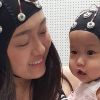
+3 +1Mothers’ and babies’ brains ‘more in tune’ when mother is happy
Mothers’ and babies’ brains can work together as a ‘mega-network’ by synchronising brain waves when they interact. The level of connectivity of the brain waves varies according to the mum’s emotional state: when mothers express more positive emotions their brain becomes much more strongly connected with their baby’s brain. This may help the baby to learn and its brain to develop.
-
 +3 +1
+3 +1The difference between an expert’s brain and a novice’s
When mice learn to do a new task, their brain activities change over time as they advance from ‘novice’ to ‘expert.’ The changes are reflected in the wiring of cell circuits and activities of neurons.
-
 +4 +1
+4 +1Link between inflammation and mental sluggishness shown in new study
...
-
 +4 +1
+4 +1Researchers develop an AI system with near-perfect seizure prediction
We've seen a smart arm bracelet that can predict nightly seizures, but now a pair of researchers have created something even more promising: an AI system that can predict epileptic seizures with 99.6-percent accuracy. Even better, it can do so up to an hour before they occur. As IEEE Spectrum reports, that gives people enough time to prepare for the attack by taking medication.
-
 +21 +1
This AI decodes your brainwaves and draws what you're looking at
The mind-reading tech works without brain implants.
-
 +17 +1
Scientists discover mood-altering brain receptor
A brain receptor believed to be linked to negative moods has been discovered in a part of the brain that contributes to pain. The paper is published in Science.
-
 +4 +1
+4 +1What your friends’ brains look like when they think of you
If you ever wondered what’s going on in your friends’ brains when they think about you, new research may provide a clue. It turns out that the brain activity patterns found in your friends’ brains when they consider your personality traits may be remarkably similar to what is found in your brain when you think of yourself, the study suggests.
-
 +18 +1
Mind-Reading Tech Is Dangerously Close to Becoming a Reality
Thanks to Facebook and Elon Musk, our brains and thoughts may no longer be private anymore.
Submit a link
Start a discussion