





















-
 +13 +3
Discovery of ‘Dragon Man’ Skull in China May Add Species to Human Family Tree
Scientists on Friday announced that a massive fossilized skull that is at least 140,000 years old is a new species of ancient human. It belonged to a mature male who had a huge brain, massive brow ridges, deep set eyes and a bulbous nose. The skull had remained hidden in an abandoned well for 85 years, after a laborer came across it at a construction site in China.
-
 +4 +1
+4 +1‘Dragon Man’ skull may help oust Neandertals as our closest ancient relative
A fossil skull nicknamed “Dragon Man” has surfaced in China under mysterious circumstances, with big news for Neandertals. Dragon Man belonged to a previously unrecognized Stone Age species that replaces Neandertals as the closest known relatives of people today, researchers say.
-
 +18 +3
Mysterious Space Signals Line Up With the Cosmic Web Connecting the Universe, Scientists Find
Scientists have used a powerful radio telescope in the interior of British Columbia, Canada to gain incredible new insights about one of the universe’s most perplexing and brilliant phenomena: Fast radio bursts (FRBs), which are unexplained signals from space. Sometimes they’re one-offs, and sometimes they mysteriously repeat in regular intervals, beating out a cosmic pattern.
-
 +9 +3
+9 +3Hundreds of mysterious fast radio bursts detected in space
Hundreds of mysterious fast radio bursts have been detected in space thanks to a Canadian telescope and an international group of researchers. The origins of these bright, millisecond-long flashes of light are unknown because the bursts, or FRBs, are unpredictable and vanish quickly. Scientists first observed them in 2007. In the decade following, they only observed about 140 bursts across the universe.
-
 +15 +3
24,000-year-old organisms found frozen in Siberia can still reproduce
A microscopic worm-like creature, labelled an “evolutionary scandal” by biologists for having thrived for millions of years without having sex, has now been shown to persist for at least 24,000 years in Siberian permafrost and then reproduce, researchers have found.
-
 +14 +3
Collapsing star produces one of the most fantastic explosions ever seen
When some stars die, they collapse and go supernova, creating bright flashes of gamma rays and X-rays known as gamma-ray bursts. GRBs are thought to be the biggest explosions in the universe, and now scientists have observed one closer than ever before, leading to a surprise that challenges our understanding of the massive blasts that can also give birth to black holes.
-
 +16 +3
‘A huge surprise’ as giant river otter feared extinct in Argentina pops up
“It was a huge surprise,” said Sebastián Di Martino, director of conservation at Fundación Rewilding Argentina. “I was incredulous. An incredible feeling of so much happiness. I didn’t know if I should try to follow it or rush back to our station to tell the others.”
-
 +24 +4
Neanderthal remains unearthed in Italian cave
Archaeologists in Italy have discovered the remains of nine Neanderthals who may have been hunted by hyenas, in a prehistoric cave south-east of Rome. The fossilized bones, which include skull fragments and broken jawbones, were found in the Guattari Cave in the coastal town San Felice Circeo.
-
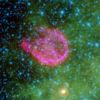 +19 +5
Extraterrestrial radioactive isotope found in seabed has implications for Earth's origins
The first-ever discovery of an extraterrestrial radioactive isotope on Earth has scientists rethinking the origins of the elements on our planet. The tiny traces of plutonium-244 were found in ocean crust alongside radioactive iron-60. The two isotopes are evidence of violent cosmic events in the vicinity of Earth millions of years ago.
-
 +10 +4
Some mammals can breathe through their butt, scientists discover
A long time ago, ancient fish swam in a harsh aquatic environment, with scarce light and limited oxygen. Many died but some survived and evolved, eventually giving rise to Misgurnus anguillicaudatus — a type of loach fish common in parts of East Asia. The loach fish’s secret survival mechanism? A unique form of intestinal breathing via their posterior.
-
 +15 +3
Physicists Discover a New Mysterious Type of Aurora
In a recent study, physicists with the University of Iowa say they have discovered a new new feature of auroras – the brilliant natural light displays predominantly seen near Earth’s high-latitude regions.
-
 +20 +3
Scientists discover ‘hellish’ world with temperatures so hot that metal instantly vapourises
A ‘hellish’ world that could be the hottest planet in the known universe has just been discovered by scientists. TOI-1431b, also known as MASCARA-5b, was found 490 light-years from Earth. Nearly twice as large as Jupiter, the planet reaches temperatures that exceed the scorching red dwarf stars in our own Milky Way galaxy.
-
 +13 +4
Enceladus may have ocean currents like we see around Antarctica
The ocean of the water-spurting moon Enceladus might be more active than scientists realized. New theories based on the shape of the ice shell suggest that 12 miles (20 kilometers) below the surface, the ocean inside Saturn's icy moon may have currents similar to those on Earth.
-
 +19 +3
Mysterious rumblings from inside of Mars detected by NASA lander
Scientists at NASA have reported an exciting detection by its Insight lander on Mars - mysterious rumblings coming from the interior of the planet. The researchers believe the seismic events may be caused by a sudden release of energy from the planet's interior, but the nature of that release remains unknown and puzzling.
-
 +9 +2
+9 +2New images of M87’s black hole reveal magnetized ring around it
In the nearly galaxy M87, more than 50 million light years from Earth, a supermassive black hole feeds on vast clouds of gas and dust. Jets, more than 5,000 light years long, erupt from this enigmatic body six billion times more massive than the Sun. In 2019, the first detailed images ever recorded of the region around a black hole were released, showing a bright ring-like structure surrounding a dark void.
-
 +29 +6
Cern experiment hints at new force of nature
Scientists at the Large Hadron Collider near Geneva have spotted an unusual signal in their data that may be the first hint of a new kind of physics. The LHCb collaboration, one of four main teams at the LHC, analysed 10 years of data on how unstable particles called B mesons, created momentarily in the vast machine, decayed into more familiar matter such as electrons.
-
 +19 +3
Boy finds 480 million-year-old fossil in garden using set he got for Christmas
A six-year-old boy has found a fossil up to 488 million years old while digging in his garden with a fossil-hunting set he received for Christmas. Siddak Sing Jhamat, known as Sid, had been digging in his garden in Walsall, in the West Midlands, "for worms and things like pottery and bricks", he said.
-
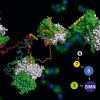 +21 +2
First 3D Images of a Giant Molecule
Capturing the structure of large molecular complexes with variable shape is an extremely difficult task. Scientists from Würzburg and Montpellier now have been able to do it – thanks to a new approach regarding an important protein machine.
-
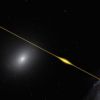 +21 +4
Scientists Find New Patterns In Mysterious Radio Pulses From Distant Galaxies
The strange signals known as “fast radio bursts” (FRBs) have long mystified the astronomy community. The sudden, strong radio pulses, often emanating from distant galaxies, appear at regularly timed intervals, from every few of milliseconds to weeks — and we still aren’t entirely sure what they are or why they exist.
-
 +19 +4
Archaeologists find earliest colonial site in Maryland after nearly 90-year search
After 300 years, Maryland experts find the historic site of St. Mary’s fort. Archaeologists have located the lost palisade that guarded the state’s first European settlement in 1634.
Submit a link
Start a discussion