



















-
 +13 +1
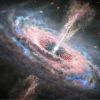
In a first, JWST detected starlight from distant galaxies with quasars
Until JWST’s sharp infrared eyes came along, it wasn’t possible to see the galaxies hosting extremely bright supermassive black holes called quasars.
-
 +15 +8
Watch live as two Russian cosmonauts conduct spacewalk
Though we all have differences, there’s one commonality that has prevailed for all of humanity: we are all floating on a rock, flying through outer space at over a million miles an hour. Thanks to the rapid advancement of technology in the past century, we can observe much more of the universe than we ever thought possible.
-
 +30 +8
We could see the glint off giant cities on alien worlds, suggests paper
How large would an extraterrestrial city have to be for current telescopes to see it? Would it need to be a planet-sized metropolis like Star Wars' Coruscant? Or could we see an alien equivalent of Earth's own largest urban areas, like New York City or Tokyo?
-
 +16 +4
We Live in the Rarest Type of Planetary System
A planetary system is shaped at the boundary of order and chaos. It starts out as a molecular cloud—a big, cold clump of mostly hydrogen gas that can collapse to make stars. As central stars form, the remainder of the cloud flattens into a whirling protoplanetary disk that weaves together worlds from turbulent swirls of gas, ice and dust. From there larger-scale chaos can ensue as bigger planets push smaller ones around.
-
 +23 +4
Missing Stars Puzzle Astronomers: Could Intelligent Life Be the Cause?
Over a period of 70 years, thousands of stars have vanished from the sky; Which prompted a team of astronomers to shed light on this phenomenon .. and perhaps a (very weak) hope of uncovering traces of intelligent civilizations outside the planet.
-
 +23 +3
Scientists hope Euclid telescope will reveal mysteries of dark matter
European space probe will capture images that will provide insights about what the universe is made of
-
 +21 +1
Where did Earth get its water? It was sucked up from space, new theory says
The theory could have important implications for the search for life outside the solar system.
-
 +4 +1
+4 +1Virgin Galactic plans first commercial space flight this month
Virgin Galactic has sold about 800 tickets over the past decade, with the initial batch going for $200,000 each.
-
 +4 +1
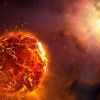
+4 +1The mysterious behavior of this Supergiant star hints at an impending supernova, new study
The bright, red star Betelgeuse in the constellation Orion has shown some unexpected behaviour.
-
 +19 +6
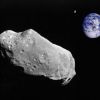
Titanic asteroid the size of 84 orcas to pass Earth on Monday
A massive asteroid the size of 84 orcas is set to pass by the Earth on Monday, June 12, according to NASA's asteroid tracker. The asteroid in question has been designated 488453 (1994 XD), according to the Center for Near-Earth Object Studies (CNEOS) at NASA's Jet Propulsion Laboratory (JPL). Despite the initials, it has nothing to do with the XD emoticon some older users of SMS and instant messaging may recognize.
-
 +15 +3
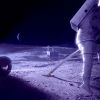
NASA Says There May Be Life on the Moon After All
NASA researchers say Moon astronauts should consider that microbial life could survive in shadowed niches near the south pole.
-
 +14 +3
Using photosynthesis for Martian occupation—while making space travel more sustainable
Researchers are working on sustainable technology to harvest solar power in space—which could supplement life support systems on the moon and Mars. In a study published in Nature Communications, scientists assess a new technique which could convert renewable, green energy from outside the Earth's atmosphere. They are taking advantage of photosynthesis—the chemical process plants undergo every day to create energy—to help the space industry become more sustainable.
-
 +29 +5
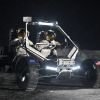
NASA's new moon car for Artemis astronauts will be inspired by Mars rovers
NASA wants more than just a lunar golf cart.
-
 +4 +1
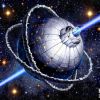
+4 +1Repeated signals from the center of the Milky Way could be aliens saying hello, new study claims
Could intelligent aliens be lurking at the heart of the Milky Way? A new search for extraterrestrial life aims to find out by listening for radio pulses from the center of our galaxy. Narrow-frequency pulses are naturally emitted by stars called pulsars, but they're also used deliberately by humans in technology such as radar.
-
 +27 +4
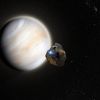
1st-ever private Venus mission delayed until at least 2025
Rocket Lab had aimed to launch the mission this year.
-
 +15 +2
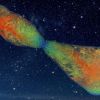
A simulation of a dying star shows how it could create gravitational waves
Cocoons of debris around dying stars could shake ripples in spacetime unlike any astronomers have ever seen. “This is a potential source of gravitational waves that has never been investigated before,” astrophysicist Ore Gottlieb of Northwestern University in Evanston, Ill., said June 5 in a news conference at the American Astronomical Society meeting in Albuquerque.
-
 +4 +1
+4 +1Scientists discover mysterious cosmic threads in Milky Way
Horizontal structures, up to 10 light years in length, appear to point in direction of galaxy’s black hole
-
 +24 +2
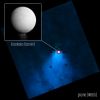
Saturn's moon Enceladus is blasting a plume of water 6,000 miles high. Could life be lurking under its icy shell?
At 6,000 miles high, the plume is 20 times as wide as the tiny ice-covered moon.
-
 +21 +6
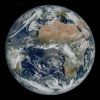
Stunning Photo of Earth Taken by Europe's Powerful New Satellite
The European Space Agency (ESA) has released a stunning photo of Earth from its latest satellite imager that captures weather conditions in never-before-seen detail.
-
 +16 +1
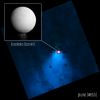
Webb maps surprisingly large plume jetting from Saturn’s moon Enceladus
A water vapour plume from Saturn’s moon Enceladus spanning more than 9600 kilometres — long enough to stretch across the Eurasian continent from Ireland to Japan — has been detected by researchers using the NASA/ESA/CSA James Webb Space Telescope. Not only is this the first time such water ejection has been seen over such an expansive distance, but Webb is also giving scientists a direct look, for the first time, at how this emission feeds the water supply for the entire system of Saturn and its rings.
Submit a link
Start a discussion