



















-
 +10 +1
Quantum Computing Will Never Work
Amid the gush of money and enthusiastic predictions being thrown at quantum computing comes a proposed cold shower in the form of an essay by physicist Mikhail Dyakonov published in IEEE Spectrum this month – The Case Against Quantum Computing. Whatever your view of QC’s prospects, Dyakonov’s commentary is worth a read. Error correction – or more accurately the inability to monitor variables and correct errors at the scale required – is the big stumbling block, he writes, but there is a good deal more to his piece.
-
 +16 +1
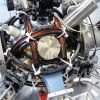
Quantum 'compass' promises navigation without using GPS
GPS is vital to modern navigation, but it's extremely fragile. Never mind coverage -- if a satellite fails or there's a jamming attack, it quickly becomes useless. Scientists may have a much more robust answer, though. Scientists have demonstrated a "commercially viable" quantum accelerometer that could provide navigation without GPS or other satellite technology. The device uses lasers to cool atoms to extremely low temperatures, and then measures the quantum wave properties of those atoms as they respond to acceleration.
-
 +22 +1
Physicists Just Made Quantum Data Storage Easier
Quantum physicists from the University of Alberta, Canada, announced this week that they have developed a new technique for storing quantum information into pulses of light. The physicists created "a new way to store pulses of light—down to the single-photon level—in clouds of ultracold rubidium atoms, and to later retrieve them on demand by shining a ‘control' pulse of light,” Lindsay LeBlanc, assistant professor of physics and Canada Research Chair in Ultracold Gases for Quantum Simulation, said.
-
 +13 +1
Here’s what the quantum internet has in store
A future ‘quantum internet’ could find use long before it reaches technological maturity, a team of physicists predicts. Such a network, which exploits the unique effects of quantum physics, would be fundamentally different to the classical Internet we use today, and research groups worldwide are already working on its early stages of development. The first stages promise virtually unbreakable privacy and security in communications; a more mature network could include a range of applications for science and beyond that aren’t possible with classical systems, including quantum sensors that can detect gravitational waves.
-
 +17 +1
The Coming Quantum Leap in Computing
The buzz gets louder, the potential is huge, but the hurdles remain high. When will quantum computing make its mark on business? Our recent research says the answer may be sooner than many people think. Quantum computing is not a replacement for the binary classical computing that has become a staple of modern life. But to paraphrase Nobel laureate Richard Feynman, because quantum computers use quantum physics to emulate the physical world, they can solve problems that today’s computers will never have the power to tackle.
-
 +13 +1
Experiment obtains entanglement of six light waves with a single laser
Austrian physicist Erwin Schrödinger (1887-1961), one of the giants of contemporary science, considered entanglement the most interesting property in quantum mechanics. In his view, it was this phenomenon that truly distinguished the quantum world from the classical world. Entanglement occurs when groups of particles or waves are created or interact in such a way that the quantum state of each particle or wave cannot be described independently of the others, however far apart they are.
-
 +9 +1
+9 +1Quantum leaps close in on 'Mt Everest of computing'
Quantum computing will be so advanced that it will make your desktop computer look like an abacus, says Stanford University professor Patrick Hayden. However Professor Hayden, who will present a public lecture in Sydney on Wednesday, is keenly aware that "the hype is just out of control at the moment".
-
 +15 +1
A new quantum device defies the concepts of ‘before’ and ‘after’
Two events can happen in different orders at the same time, thanks to quantum physics.
-
 +24 +1
This Mad New Quantum Experiment Breaks The Idea of 'Before' And 'After'
For around a century it's been thought that particles don't have defined properties until we nail them down with a measurement.
-
 +4 +1
+4 +1Quantum entanglement loophole quashed by quasar light
With the help of two extremely bright quasars located more than 7 billion light-years away, researchers recently bolstered the case for quantum entanglement — a phenomenon Einstein described as "spooky action at a distance" — by eliminating one classical alternative: The freedom-of-choice loophole.
-
 +17 +1
We May Soon Know How a Crucial Einstein Principle Works in The Quantum Realm
The puzzle of how Einstein's equivalence principle plays out in the quantum realm has vexed physicists for decades. Now two researchers may have finally figured out the key that will allow us to solve this mystery.
-
 +12 +1
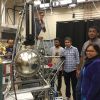
Team discovers a first-of-its-kind material for the quantum age
A UCF physicist has discovered a new material that has the potential to become a building block in the new era of quantum materials, those that are composed of microscopically condensed matter and expected to change our development of technology.
-
 +13 +1
Reversing cause and effect is no trouble for quantum computers
Watch a movie backwards and you'll likely get confused—but a quantum computer wouldn't.
-
 +14 +1
Microscopic trampoline may help create networks of quantum computers
A microscopic trampoline could help engineers to overcome a major hurdle for quantum computers, researchers from the University of Colorado Boulder and the National Institute of Standards and Technology (NIST) report in a new study. Scientists at JILA, a joint institute of CU Boulder and NIST, have developed a device that uses a small plate to absorb microwave energy and bounce it into laser light--a crucial step for sending quantum signals over long distances.
-
 +11 +1
How quantum computers could steal your bitcoin
It is hard to predict when quantum computers will be strong and fast enough to crack the codes that keep bitcoin safe. But that day is coming.
-
 +34 +1
How quantum physics gives parrots their colourful feathers
Unlike other birds, parrots don't rely on what they eat to colour their feathers. Instead they rely on some fancy feather physics. By Belinda Smith.
-
 +12 +1
Chinese scientists break quantum computing world record
Chinese physicists have achieved quantum entanglement with 18 qubits, surpassing the previous world record of 10. This represents a step toward realizing large-scale quantum computing, according to a recent study published in the journal Physical Review Letters. Quantum entanglement is a phenomenon in which two or more entangled subatomic particles, or qubits, can theoretically affect each other simultaneously regardless of distance. The idea was so counterintuitive that Albert Einstein mocked it as "spooky action at a distance."
-
 +10 +1
Quantum leap in computer simulation
University of Melbourne physicists have successfully simulated a quantum computer faster than any real prototype in a key step to help us become quantum-ready.
-
 +15 +1
Particles Have Been Entangled 'on Demand' For The First Time, And It's a Game Changer
Quantum technology promises big things for digital security and computing power, but the very thing it relies upon - quantum entanglement - has so far proven too fickle to reliably control.
-
 +11 +1
We've designed a 'flux capacitor', but it won't take us Back to the Future
Physicists have designed an electrical component that break's time-reversal symmetry. Not quite the time machine from Hollywood but it should help with communication technology and quantum computing.
Submit a link
Start a discussion