




















-
 +21 +3
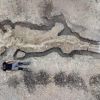
Huge ‘sea dragon’ named one of UK’s greatest fossil finds
A gigantic prehistoric “sea dragon” discovered in the Midlands has been described as one of the greatest finds in the history of British palaeontology. The ichthyosaur, which is about 180m years old with a skeleton measuring about 10 metres in length and a skull weighing about a tonne, is the largest and most complete fossil of its kind ever found in the UK. Joe Davis of the Leicestershire and Rutland Wildlife Trust discovered it during the routine draining of a lagoon island at the Rutland Water reservoir in February 2021.
-
 +4 +1
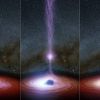
+4 +1NASA Just Saw Something Come Out Of A Black Hole For The First Time Ever
You don't need to be an expert in science to understand that black holes often pull things in rather than spit them out. However, NASA has just discovered something quite weird around the supermassive black hole Markarian 335.
-
 +12 +3
A newly discovered molecule could lead to a cure for pancreatic cancer
It's the dreaded C-word: Cancer. Some dare not even say it in case it happens to them. Despite many advances in science, we are still at a loss for an effective cure for cancer. Now, a research team led by scientists at Roswell Park Comprehensive Cancer Center may have made a significant breakthrough in treating pancreatic cancer, according to a press release published by the institute on Wednesday.
-
 +17 +4
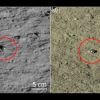
Chinese Rover Spots Unusual Glass Beads on Far Side of the Moon
A pair of translucent glass spheres, each measuring over a half-inch thick, have been spotted in an impact crater near the lunar south pole. They’re the first of their kind to ever be discovered on the Moon. New research in Science Bulletin describes the “the first discovery of macroscopic and translucent glass globules on the Moon.” The beads likely formed from the heat generated by a violent impact or possibly from early volcanic activity.
-
 +3 +1
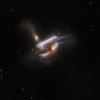
+3 +1Hubble captures stunning image of three galaxies merging 681 million light years away
When galaxies merge, the clouds of gas and dust that are part of galaxies collide with each other, sometimes resulting in the formation of new stars.
-
 +22 +3
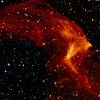
Fast and furious: A shock wave that extends for 6.5 million light years
An international team of astronomers made the most detailed images of the largest cosmic shock wave visible from earth. These gigantic shock waves are much larger than our entire galaxy and they form when clusters of galaxies collide in what are the most energetic events after the Big Bang.
-
 +13 +2
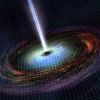
Twin Brown Dwarfs Discovered, Orbiting one Another at Three Times the Distance From the Sun to Pluto
Gravity is a funny force. The gravity of every given object technically impacts every other given object, though, in practice, large distance and small masses make those forces negligible for such interactions. But in some cases, especially when large groups are floating in empty space, gravity can still hold sway over considerable distances. Such is the case with a new pair of brown dwarfs found by astronomers at the Keck Observatory.
-
 +19 +5
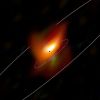
Black hole behind a cosmic ring of dust
Using the Very Large Telescope of the European Southern Observatory (ESO), an international team of astronomers has unveiled this supermassive gravity trap. The researchers, including scientists from the Max Planck Institutes for Astronomy and Radio Astronomy, gained new insights into the mechanisms of active galactic nuclei, some of the brightest and most enigmatic objects in the universe. They also confirmed a 30-year-old theory.
-
 +13 +4
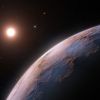
Tiny new planet discovered around Sun's nearest neighbor
Astronomers may have detected a new exoplanet around Proxima Centauri, the star closest to our solar system. This tiny new world is one of the lightest ever discovered, which is even more impressive given the technique the team used to find it.
-
 +15 +1
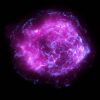
1st image from NASA's new IXPE X-ray telescope looks like a ball of purple lightning
NASA's newly-launched X-ray hunting probe has snapped its first science image and — wow — it's spectacular. The Imaging X-ray Polarimetry Explorer (IXPE) probe launched Dec. 9, 2021, on a mission to observe objects like black holes and neutron stars in X-ray light, shedding much-anticipated light on the inner workings of the cosmos. The probe spent its first month in space checking out its various systems to get ready to capture its first images, and now the IXPE team has released its very first science image.
-
 +7 +1
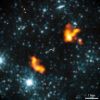
+7 +1The Biggest Galaxy Ever Found Has Just Been Discovered, And It Will Break Your Brain
Astronomers have just found an absolute monster of a galaxy. Alcyoneus is a massive radio galaxy 3 billion light-years away that reaches 5 megaparsecs into space. This structure, which is 16.3 million light-years long, is the largest known structure of galactic origin.
-
 +10 +1
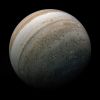
NASA space telescope spots most powerful light ever seen on Jupiter, helps solve 30-year-old mystery
NASA has detected the most energetic light ever seen on Jupiter and, in the process, solved a 30-year-old mystery. In a new study, researchers using NASA's Nuclear Spectroscopic Telescope Array (NuSTAR) space observatory were able to spot the highest-energy light ever seen on Jupiter. The light, which is X-ray radiation, is also the highest-energy light ever seen on a planet in our solar system other than Earth.
-
 +4 +1
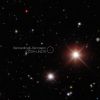
+4 +1Largest comet ever observed bumps Hale-Bopp from pedestal
The 85-mile-wide Bernardinelli-Bernstein comet is winging its way toward the interior of the solar system.
-
 +19 +4
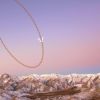
Asteroid sharing Earth’s orbit discovered – could it help future space missions?
Research has shown that the Earth trails an asteroid barely a kilometre across in its orbit about the Sun – only the second such body to have ever been spotted. It goes round the Sun on average two months ahead of the Earth, dancing around in front like an excited herald of our coming.
-
 +3 +1
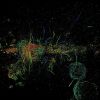
+3 +1Astronomers discover 1,000 strange 'filaments' of radio energy bursting from the galaxy's center
Researchers gazing into the center of the Milky Way with one of the world's largest radio telescope arrays have discovered thousands of mysterious strand-like structures never seen before.
-
 +20 +5
A rare find: Archaeologists unearth 4,000-year-old board game in Oman
Archaeologists working in Oman's Qumayrah Valley recently unearthed a rare artifact: a stone board game dating back some 4,000 years. The board features grid-like markings (possibly indicating fields) and holes for cups. It was found at a site near the village of Ayn Bani Saidah.
-
 +2 +1
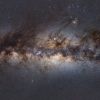
+2 +1Australia scientists find 'spooky' spinning object in Milky Way
Australian scientists say they have discovered an unknown spinning object in the Milky Way that they claim is unlike anything seen before. The object - first discovered by a university student - has been observed to release a huge burst of radio energy for a full minute every 18 minutes. Objects that pulse energy in the universe are often documented. But researchers say something that turns on for a minute is highly unusual.
-
 +19 +1
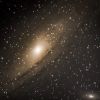
Astrophysicists May Have Found a Rare Species of Black Hole in the Andromeda Galaxy
A team of astrophysicists believe that a glob of stars in our next-door galaxy is hiding an intermediate-mass black hole, a type predicted to exist but that has never been observed for certain. The globular cluster in question is called B023-G078, and it’s situated on the outskirts of the Andromeda Galaxy, about 2.5 million light-years away. The researchers believe the cluster, which contains the mass of 6.2 million Suns, is actually a stripped nucleus: the remains of several small galaxies that glommed together.
-
 +14 +4
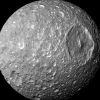
Saturn's 'Death Star' moon may have a secret ocean, revealing a new category of worlds that could host alien life
NASA is studying several moons of Saturn and Jupiter that carry oceans of liquid water deep beneath their surfaces, where alien life could thrive. Another moon, previously assumed to be a barren ice rock, might join their ranks.
-
 +26 +3
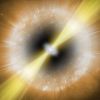
An X-ray glow suggests black holes or neutron stars fuel weird cosmic ‘cows’
A brilliant blast from a galaxy 2 billion light-years away is the brightest cosmic “Cow” found yet. It’s the fifth known object in this new class of exploding stars and their long-glowing remnants, and it’s giving astronomers even more hints of what powers these mysterious blasts.
Submit a link
Start a discussion