




















-
 +17 +2
Wayward Satellites Test Einstein's Theory of General Relativity
The botched launch of two Galileo navigation probes made for an unexpected experiment
-
 +19 +2
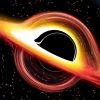
Maybe You Really Can Use Black Holes to Travel the Universe
One of the most cherished science fiction scenarios is using a black hole as a portal to another dimension or time or universe. That fantasy may be closer to reality than previously imagined. Black holes are perhaps the most mysterious objects in the universe. They are the consequence of gravity crushing a dying star without limit, leading to the formation of a true singularity – which happens when an entire star gets compressed down to a single point yielding an object with infinite density.
-
 +2 +1
+2 +1Hidden history of the Milky Way revealed by extensive star maps
Data from the Gaia spacecraft are radically transforming how we see the evolution of our Galaxy. By Adam Mann.
-
 +12 +3
How to Measure All the Starlight in the Universe
Astrophysicists have devised a clever way to count up the photons in space, stretching back to the cosmos’ adolescence. Until the 20th century, astronomers were stuck on a question that seems as if it should have an easy answer: Why is the night sky dark? If the infinite universe has an infinite numbers of stars, as they assumed, our evening view should be awash in their glow.
-
 +21 +2
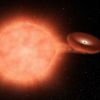
Study witnesses first moments of star dying in finest detail
An international research team including The Australian National University (ANU) has used the Kepler space telescope in coordination with ground-based telescopes to witness the first moments of a star dying in unprecedented detail. The astronomers witnessed the star dying a long time ago in a galaxy far, far away, as part of a project that aims to solve the mystery of how stars explode.
-
 +1 +1
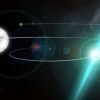
+1 +1Trio of stars shows Einstein is still right about relativity
Everything falls the same, from the lightest feather to the heaviest star. That’s part of the foundation of Albert Einstein’s theory of general relativity. Now, observations of three stars orbiting one another have confirmed that it holds up even for some of the heaviest objects in the universe.
-
 +25 +7
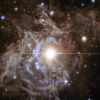
Cosmic expansion rate remains a mystery despite new measurement
A new value for the Hubble constant – the expansion rate of the universe — has been calculated by an international group of astrophysicists. The team used primordial distance scales to study more than 200 supernovae observed by telescopes in Chile and Australia. The new result agrees well with previous values of the constant obtained using a specific model of cosmic expansion, while disagreeing with more direct observations from the nearby universe – so exacerbating a long-running disagreement between cosmologists and astronomers.
-
 +18 +5
Meet the woman who discovered a whole new type of galaxy
As a child growing up in Turkey, astrophysicist Burçin Mutlu-Pakdil used to enjoy looking up at the stars in the night sky. Little did she know that thanks to her scientific skills, a galaxy sitting 359 million light-years from Earth would one day bear her name. Mutlu-Pakdil’s lifelong passion for astrophysics was born when she had to prepare an assignment in middle school on an interesting person. “I asked my sister for suggestions on who I should choose for my assignment, and she suggested Einstein, because he’s the cleverest man in the world,” Mutlu-Pakdil says.
-
 +20 +2
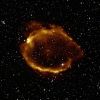
Data details dynamically driven double-degenerate double-detonation supernova theory
The identification of three white dwarf stars zooming at hyper-fast velocities might provide evidence to support an alternative theory explaining the formation of Type 1a supernovae, researchers say. Type 1a supernovae, orthodoxy holds, arise when two white dwarf stars locked in a binary orbit merge with each other, kick-starting a runaway nuclear fusion reaction and consequent massive explosion.
-
 +13 +4
Scientists Create Rare Fifth Form of Matter in Space for the First Time Ever
Scientists have created the coldest spot in the universe, giving them the opportunity to study the universe's rare fifth form of matter.
-
 +24 +6
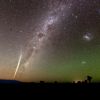
Just how massive is the Milky Way?
A first of its kind study uses angular momentum of satellite galaxies to weigh the Milky Way, providing a testing ground for the widely theorized cold dark matter theory.
-
 +3 +1
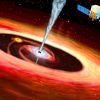
+3 +1In a first, astronomers find a blazar that cycles every two years
After 10 years of observations, scientists have confirmed a two-year cycle in the gamma-ray brightness of a blazar, or a galaxy with a supermassive black hole that consumes mass and produces high-energy jets as a result. Blazars are the most energetic and luminous objects that we have identified so far in the known universe.
-
 +36 +4
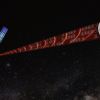
Mathematicians confirm the possibility of data transfer via gravitational waves
It turned out that there is the possibility of transmitting information with the help of nonmetricity waves and transferring it spatially without distortions.
-
 +16 +2
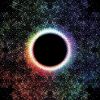
How Do You Take a Picture of a Black Hole? With a Telescope as Big as the Earth
We live 26,000 light-years from the center of the Milky Way. That’s a rounding error by cosmological standards, but still — it’s far. When the light now reaching Earth from the galactic center first took flight, people were crossing the Bering Strait land bridge, hunting woolly mammoths along the way.
-
 +17 +2
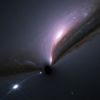
Black holes ruled out as universe’s missing dark matter
For one brief shining moment after the 2015 detection of gravitational waves from colliding black holes, astronomers held out hope that the universe’s mysterious dark matter might consist of a plenitude of black holes sprinkled throughout the universe. UC Berkeley physicists have dashed those hopes.
-
 +14 +1
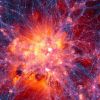
Scientists Pinpoint Where Dark Matter Is Hiding in the Universe
There's a huge amount of matter in the universe that we can't directly see. But scientists can tell it's there. They call it dark matter. They know it's there because its gravity tugs on the stars and galaxies around it, altering their movement. Dark matter also tugs on light as it passes, bending its path, a phenomenon called gravitational lensing. And now, by studying where that lensing appears in the sky, an international team of scientists have released a detailed, 3D map[BI1] of dark matter.
-
 +15 +3
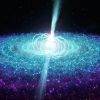
Powerful jets found shooting from neutron star with incredible magnet
For the first time, astronomers have witnessed a fast-moving jet of material shooting outward from a neutron star with an extremely powerful magnetic field — one that is some 10 trillion times stronger than the Sun's. The surprising discovery not only caught researchers off guard, but is also forcing them to fundamentally rethink their current theories regarding how jets form throughout the cosmos.
-
 +20 +3
British astrophysicist overlooked by Nobels wins $3m award for pulsar work
Dame Jocelyn Bell Burnell will donate the money to help students underrepresented in physics
-
 +2 +1
+2 +1Gamma-Rays Spewed As a Black Hole Forms Might 'Reverse Time'
They seem to reverse time. By Yasemin Saplakoglu.
-
 +16 +2
Early Opaque Universe Linked to Galaxy Scarcity
A team of astronomers led by George Becker at the University of California, Riverside, has made a surprising discovery: 12.5 billion years ago, the most opaque place in the universe contained relatively little matter. It has long been known that the universe is filled with a web-like network of dark matter and gas. This “cosmic web” accounts for most of the matter in the universe, whereas galaxies like our own Milky Way make up only a small fraction.
Submit a link
Start a discussion