




















-
 +34 +5
A physicist proposed a pretty depressing explanation for why we've never seen aliens
The Universe is so unimaginably big, and it's positively teeming with an almost infinite supply of potentially life-giving worlds. So where the heck is everybody? At its heart, this is what's called the Fermi Paradox: the perplexing scientific anomaly that despite there being billions of stars in our Milky Way galaxy — let alone outside it — we've never encountered any signs of an advanced alien civilization, and why not?
-
 +7 +1
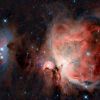
+7 +1Matter around a young star helps astronomers explore our stellar history
Astronomers have mapped the substance aluminum monoxide in a cloud around a distant young star -- Origin Source I. The finding clarifies some important details about how our solar system, and ultimately we, came to be.
-
 +15 +5
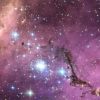
The universe may be a billion years younger than we thought. Scientists are scrambling to figure out why.
New research suggests that the Big Bang that birthed the cosmos occurred 12.5 billion years ago.
-
 +29 +3
Danger lurking in stunning meteor shower
Every year, Earth passes through the tail of the comet Encke - twice. This isn’t unusual. We regularly cross cometary trails of ice and dust. But this one may be different.
-
 +5 +1
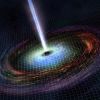
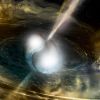
+5 +1Some of Earth's Gold Came From Two Neutron Stars That Collided Billions of Years Ago
For about a century now, scientists have theorized that the metals in our Universe are the result of stellar nucleosynthesis. This theory states that after the first stars formed, heat and pressure in their interiors led to the creation of heavier elements like silicon and iron. These elements not only enriched future generations of stars (“metallicity”), but also provided the material from which the planets formed.
-
 +4 +1
+4 +1Merging neutron stars gave solar system heavy elements
Astronomy.com is for anyone who wants to learn more about astronomy events, cosmology, planets, galaxies, asteroids, astrophotography, the Big Bang, black holes, comets, constellations, eclipses, exoplanets, nebulae, meteors, quasars, observing, telescopes, NASA, Hubble, space missions, stargazing, and more
-
 +10 +2
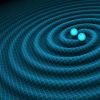
Theorist calculates the incalculable siren song of merging black holes
Just a month into a renewed observing campaign with a trio of detectors, physicists today announced they have spotted more gravitational waves—fleeting ripples in space set off when two massive objects such as black holes spiral into each other. The collaboration has now bagged 13 merging black hole pairs, as well as two pairs of neutron stars. But even as detections accumulate, one theorist has made an advance that could change how the team analyzes the signals and make it easier to test Albert Einstein’s theory of gravity, general relativity.
-
 +2 +1
+2 +1The Sun Is Stranger Than Astrophysicists Imagined
The sun radiates far more high-frequency light than expected, raising questions about unknown features of the sun’s magnetic field and the possibility of even more exotic physics.
-
 +6 +1
+6 +1Astronomers watch as a black hole's jet wobbles like a top
Back in 2015, the black hole V404 Cygni got the attention of astronomers all over the globe when it suddenly brightened for two weeks. The outburst happened as the black hole began gobbling up material from a star that orbits it once every six days. As the material swirled into the black hole, it heated up enough to glow brightly. Then, the black hole starting shooting some of that material far out into space as bright jet beams. When astronomers took a close look at the jets, they realized they were wobbling like a top.
-
 +16 +2
The universe is expanding faster than we thought, and no one knows why
Explaining a discrepancy between what was happening 13 billion years ago and now may require new physics.
-
 +1 +1
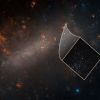
+1 +1The Universe Is Expanding So Fast We Might Need New Physics to Explain It
The universe is expanding faster than expected, suggesting that astronomers may have to incorporate some new physics into their theories of how the cosmos works, a new study reports. The revised expansion rate is about 10% faster than that predicted by observations of the universe's trajectory shortly after the Big Bang, according to the new research. The study also significantly reduces the probability that this disparity is a coincidence, from 1 in 3,000 to just 1 in 100,000.
-
 +30 +3
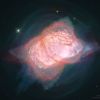
Astronomers find oldest type of molecule in space
Everything has a beginning. That’s true for stories, for people, for the universe and even for chemistry. The Big Bang itself produced just a handful of elements (variations of hydrogen, helium and lithium nuclei), so researchers have a pretty good sense of what the first atoms and molecules might have been. But the very first molecular bond to form, linking together atoms of different elements in a single molecule, has long been missing in action.
-
 +3 +1
+3 +1Historic First Images of a Black Hole Show Einstein Was Right (Again)
Albert Einstein's towering genius is on display yet again. The first-ever images of a black hole, which the Event Horizon Telescope (EHT) project unveiled today (April 10), further bolster Einstein's century-old theory of general relativity, researchers said. "Today, general relativity has passed another crucial test, this one spanning from horizons to the stars," EHT team member Avery Broderick, of the University of Waterloo and the Perimeter Institute for Theoretical Physics in Canada, said during a news conference today at the National Press Club in Washington, D.C.
-
 +58 +8
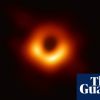
Black hole picture captured for first time in space ‘breakthrough’
A network of eight radio telescopes around the world helped to record the image
-
 +18 +2
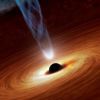
In astrophysics milestone, first photo of black hole expected
Scientists are expected to unveil on Wednesday the first-ever photograph of a black hole, a breakthrough in astrophysics providing insight into celestial monsters with gravitational fields so intense no matter or light can escape. The U.S. National Science Foundation has scheduled a news conference in Washington to announce a “groundbreaking result from the Event Horizon Telescope (EHT) project,” an international partnership formed in 2012 to try to directly observe the immediate environment of a black hole.
-
 +4 +1
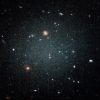
+4 +1Two Unusual Galaxies Shake Up the Dark Matter Debate, Again
When it comes to the nature of dark matter, astronomers are still largely, well, in the dark. The existence of this mysterious substance was hypothesized more than 40 years ago to explain discrepancies between the calculations of how galaxies ought to behave, based on their mass, and what was actually observed. In short, it seemed like mass was missing. So Vera Rubin, the astronomer who first discovered this discrepancy, conjured an invisible substance that is far more abundant than “normal” matter and acts as the scaffolding for the large-scale structure of the universe. Today we call it dark matter.
-
 +18 +4
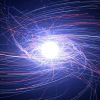
The Universe's Dark Secret: Where Did All the Antimatter Go?
Paul M. Sutter is an astrophysicist at The Ohio State University, host of Ask a Spaceman and Space Radio, and author of Your Place in the Universe. Sutter contributed this article to Space.com's Expert Voices: Op-Ed & Insights. So there's this stuff called "antimatter." You may have heard of it. It's just like normal matter, with all the same properties and all the same abilities to make up atoms and molecules, except for one crucial difference: It has an opposite charge. Take the humble electron, for example. Mass of 9.11 x 10^-31 kg. Quantum spin of 1/2. Charge of -1.6 x 10^-9 coulombs.
-
 +16 +1
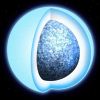
Thousands of stars turning into crystals
The first direct evidence of white dwarf stars solidifying into crystals has been discovered by astronomers at the University of Warwick. (Jan. 9, 2019)
-
 +11 +2
Watch The Late Stephen Hawking Casually Explain What Existed Before The Big Bang
Around 13.7 billion years ago, our Universe sprang into existence, but what was around before the Big Bang?
-
 +16 +3
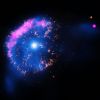
This star's been exploding every year for millions of years
Astronomers have discovered a star in the Andromeda galaxy that has been regularly erupting for the past million years, leaving behind one of the biggest shells of ejected material scientists have ever seen. The new research, which was published last month in the journal Nature, not only marks the first discovery of such a super-remnant in another galaxy, it also paves the way for detecting a potentially massive population of repeatedly exploding stars, called recurrent novae, which may help shed light on how the universe has changed over time.
Submit a link
Start a discussion