


















-
 +32 +4
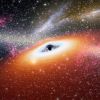
Black Hole Seeds Missing in Cosmic Garden
Scientists are working with powerful space telescopes from NASA, as well as other observatories, to track down far-flung objects that fit the description of "intermediate-mass black holes."
-
 +20 +2
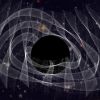
Scientists detect tones in the ringing of a newborn black hole for the first time
If Albert Einstein’s theory of general relativity holds true, then a black hole, born from the cosmically quaking collisions of two massive black holes, should itself “ring” in the aftermath, producing gravitational waves much like a struck bell reverbates sound waves. Einstein predicted that the particular pitch and decay of these gravitational waves should be a direct signature of the newly formed black hole’s mass and spin.
-
 +15 +2
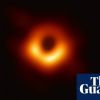
Scientists behind first image of black hole awarded $3m prize
An international collaboration that captured the first image of a black hole, a cosmic plughole from which nothing that enters can ever escape, has won the most lucrative prize in physics. Hundreds of researchers on the Event Horizon Telescope (EHT) team will share the $3m Breakthrough prize in fundamental physics for their image of the monster black hole at the heart of Messier 87, a galaxy 55m light years from Earth.
-
 +15 +3
Dark matter has never killed anyone, and scientists want to know why
“Death by Dark Matter.” That’s not the name of your new favorite metal band; it’s the literal title of a new study by a trio of American of physicists
-
 +8 +1
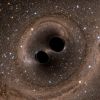
+8 +1A double whammy of gravitational waves sparks a burst of black hole speculation
Two detections of gravitational waves set off a flurry of excitement among astronomers. Was it a double observation of a single black-hole merger, or just a cosmic coincidence?
-
 +24 +2
Busy older stars outpace stellar youngsters, new study shows
The oldest stars in our Galaxy are also the busiest, moving more rapidly than their younger counterparts in and out of the disk of the Milky Way, according to new analysis carried out at the University of Birmingham.
-
 +4 +1
+4 +1Scientists Are 99% Sure They Just Detected a Black Hole Eating a Neutron Star
“If it turns out to be right, then we’ve confirmed a new type of star system. It’s that fundamental.”
-
 +7 +1
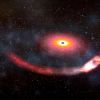
+7 +1Astronomers probably just saw a black hole swallow a dead star
Ripples in the fabric of spacetime reveal what may be a first-of-its-kind cosmic collision.
-
 +25 +8
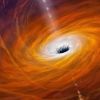
This Is Why Black Holes Must Spin At Almost The Speed Of Light
Many of them are spinning at nearly the speed of light. When you do the math, there's no other way it could have been.
-
 +4 +1
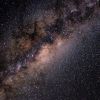
+4 +1Astronomers find traces of one of the first stars
Astronomers have found the ghostly remains of one of the Universe’s first stars inside a rare, ancient star far, far away on the other side of our galaxy. ANU astronomer Dr Thomas Nordlander said the parent of the star they discovered 35,000 light years away in the Milky Way was about 10 times the mass of our Sun and, as a result, probably didn’t live very long.
-
 +2 +1
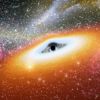
+2 +1Black hole warning: Why scientist delivered dire prospects for life on Earth – 'It's bad'
A BLACK hole approaching Earth would swallow everything in its path and it would not be a nice way to die, according to scientist Neil deGrasse Tyson.
-
 +30 +4
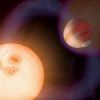
Astronomers make first calculations of magnetic activity in 'hot Jupiter' exoplanets
Gas-giant planets orbiting close to other stars have powerful magnetic fields, many times stronger than our own Jupiter, according to a new study by a team of astrophysicists. It is the first time the strength of these fields has been calculated from observations.
-
 +8 +1
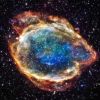
+8 +1Scientists still can’t agree on the universe’s expansion rate
A mismatch in measurements of how fast the universe is expanding might not be real, a study hints.
-
 +17 +2
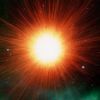
Supernova observation first of its kind using NASA satellite
When NASA’s Transiting Exoplanet Survey Satellite launched into space in April 2018, it did so with a specific goal: to search the universe for new planets.
-
 +15 +3
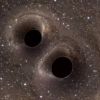
Astronomers discover two supermassive black holes in a death spiral
Using images obtained from the Hubble Space Telescope, a US collaboration of astronomers have detected two supermassive black holes on a collision course, 2.5 billion light years from Earth. The two black holes will continue to get closer to each other sending out huge ripples in space-time, known as gravitational waves, which can be detected back on Earth. Though we're not likely to detect their signal for billions of years, they will help astronomers gain a better understanding of these enormous ripples.
-
 +28 +6
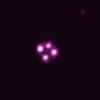
Scientists discover vortex around black hole spinning at 70 percent the speed of light
Astronomers have measured the spin rate of five, distant supermassive black holes for a study published in the Astrophysical Journal.
-
 +29 +5
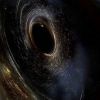
We are stardust. And Big Bang dust.
When, in 2017, the LIGO experiment detected gravitational waves from two neutron stars colliding, it sent electromagnetic and gravitational ripples through the universe and the astronomical community.
-
 +8 +1
+8 +1Three zombie stars on the run
Astronomers have discovered three peculiar runaway stars that have apparently survived cataclysmic explosions at their cores. A white dwarf is an ageing star that has burned through its original fuel. Under certain conditions, a white dwarf’s burnt-out core re-ignites; the core’s subsequent explosion is known as a supernova. Some stars are thought to survive these explosions to become so-called zombie stars.
-
 +4 +1
+4 +1Next step in black hole science: Making a 'movie'
Using machine learning and a whole lot of data from telescopes positioned around the world could test the theory of gravity in new ways.
-
 +3 +1
+3 +1Scientists ask the public to help search for a rare breed of black hole
If you have a computer and a few spare moments, you can help search the cosmos for an elusive breed of black hole that astronomers once thought didn't exist.
Submit a link
Start a discussion