



















-
 +19 +1
This Black-Hole Collision Just Made Gravitational Waves Even More Interesting
An unprecedented signal from unevenly sized objects gives astronomers rare insight into how black holes spin
-
 +18 +3
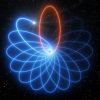
A star orbiting the Milky Way’s giant black hole confirms Einstein was right
The first sign that Albert Einstein’s theory of gravity was correct has made a repeat appearance, this time near a supermassive black hole. In 1915, Einstein realized that his newly formulated general theory of relativity explained a weird quirk in the orbit of Mercury. Now, that same effect has been found in a star’s orbit of the enormous black hole at the heart of the Milky Way, researchers with the GRAVITY collaboration report April 16 in Astronomy & Astrophysics.
-
 +8 +1
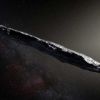
+8 +1Alien Space Rock ‘Oumuamua May be Chunk of a Shredded World
A close encounter with another star may have ripped the cigar-shaped interstellar visitor ‘Oumuamua from its parent body, flinging it toward our solar system.
-
 +13 +3
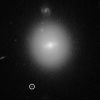
Hubble finds the best evidence yet for elusive midsized black holes
At about 50,000 times the mass of the Sun, this intermediate-mass black hole skirts the line between shrimp and giant.
-
 +12 +1
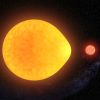
New type of pulsating star discovered
A star that pulsates on just one side has been discovered in the Milky Way about 1500 light years from Earth. It is the first of its kind to be found and scientists expect to find many more similar systems as technology to listen inside the beating hearts of stars improves.
-
 +15 +4
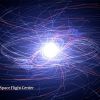
The golden age of neutron-star physics has arrived
When a massive star dies in a supernova, the explosion is only the beginning of the end. Most of the stellar matter is thrown far and wide, but the star’s iron-filled heart remains behind. This core packs as much mass as two Suns and quickly shrinks to a sphere that would span the length of Manhattan. Crushing internal pressure — enough to squeeze Mount Everest to the size of a sugar cube — fuses subatomic protons and electrons into neutrons.
-
 +19 +3
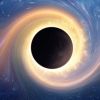
Black holes shouldn't echo, but this one might. Score 1 for Stephen Hawking?
This isn't how black holes are supposed to behave.
-
 +21 +3
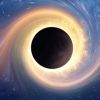
Black holes shouldn't echo, but this one might. Score 1 for Stephen Hawking?
This isn't how black holes are supposed to behave.
-
 +3 +1
+3 +1Berkeley student throws cold water on ‘monster’ black hole discovery
A discovery that made headlines in November is shot down in December, thanks to a sharp-eyed young astronomer
-
 +4 +1
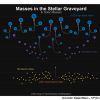
+4 +1A surprisingly big black hole might have swallowed a star from the inside out, and scientists are baffled
Astronomers using a new technique to hunt black holes found one 70 times as heavy as the Sun
-
 +6 +1
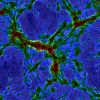
+6 +1Physicists Just Created the Most Detailed Simulation of the Universe in History
An international team of scientists has created the most detailed large-scale model of the universe to date, a simulation they call TNG50.
-
 +12 +2
Astronomers Just Found the First Evidence That 'Mini Black Holes' Exist
An entirely new class of black holes may be lurking in the universe, and these may be far tinier than what scientists have found before, according to new findings.
-
 +12 +2
Scientists may just have discovered a new class of black holes
Black holes are an important part of how astrophysicists make sense of the universe – so important that scientists have been trying to build a census of all the black holes in the Milky Way galaxy. But new research shows that their search might have been missing an entire class of black holes that they didn’t know existed.
-
 +11 +1
NASA Just Recorded A Black Hole Devour A Sun-Sized Star For The First Time Ever
Astronomers say this type of cosmic event happens once every 10,000 to 100,000 years. Events like this are not only incredibly rare but difficult to capture. NASA managed it with a state-of-the-art satellite and a network of robotic telescopes.
-
 +21 +5
Putting the “bang” in the Big Bang
As the Big Bang theory goes, somewhere around 13.8 billion years ago the universe exploded into being, as an infinitely small, compact fireball of matter that cooled as it expanded, triggering reactions that cooked up the first stars and galaxies, and all the forms of matter that we see (and are) today.
-
 +19 +3
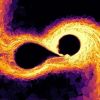
The Strongest Magnets in The Universe Could Be Formed by The Violent End of Stars
Some of the strongest magnetic fields ever detected in the Universe come from magnetars. Now, we might finally know how these strange objects form.
-
 +13 +4
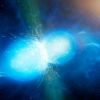
The first known heavy element created in a neutron star merger has been found
The discovery of strontium created inside a neutron star smashup gives the clearest picture yet of what goes on inside this chaotic environment.
-
 +13 +4
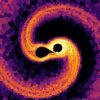
Merging stars may create the universe's most powerful magnets
New simulations suggest that when two stars collide, the resulting product can be extremely magnetic, and it may ultimately wind up as a magnetar.
-
 +17 +2
The universe's oldest black holes could also be its most useful
Primordial black holes born in the moments after the big bang could clear up some of cosmology's most confounding conundrums
-
 +4 +1
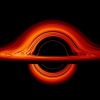
+4 +1NASA’s new black hole visualizations showcase how gravity warps light
Images from computer simulations highlight how the extreme gravity of a black hole tampers with light rays emanating from its accretion disk to create weird patterns.
Submit a link
Start a discussion