





















Mastering Content Experience Optimisation: A Practical Guide to AEO and GEO
-
Search optimisation is not the only way to get a rank on Google’s first page. There has been a transition of the digital landscape into various ecosystems, where voice assistants are coexisting with traditional search engines.
To stay visible, brands must master these two most interconnected and crucial disciplines, AEO and GEO. Here, we will explore the technical shift from SEO fundamentals to advanced-GEO tactics for advanced AI platforms.
Transition from SEO to Advanced AEO and GEO
As search engine incorporates AI, users' behaviour is changing. A majority of searches now result in zero-click outcomes, where the user’s question is answered directly on SERP. While traditional SEO aims to drive traffic to your site, AEO and GEO ensure your brand remains visible and authoritative even in these new formats.
What is Answer Engine Optimisation (AEO)?
Answer Engine Optimisation (AEO) is a digital marketing strategy focused on optimising content to be the direct, concise answer rather than just appearing in a list of links. AEO prioritises making content easily extractable and citeable through answer engines like ChatGPT, Alexa, or Siri. It mainly focuses on clear, structured, and authoritative content to get your brand featured directly in the search results themselves.
What is Generative Engine Optimisation (GEO)?
Generative Engine Optimisation (GEO) is the practice of optimising content for visibility within AI-powered search engines and large language models. GEO aims to get your content cited through a machine learning process in AI-generated responses.
This is done through practices like aligning content with an AI model’s natural language processing (NLP). Additionally, it structures your content to match user intent and improves overall brand authority.
Why Answer Engine Optimisation is Critical in 2025?
Here are some of the reasons why AEO is critical for businesses to remain visible in Google’s SERP:
-
-
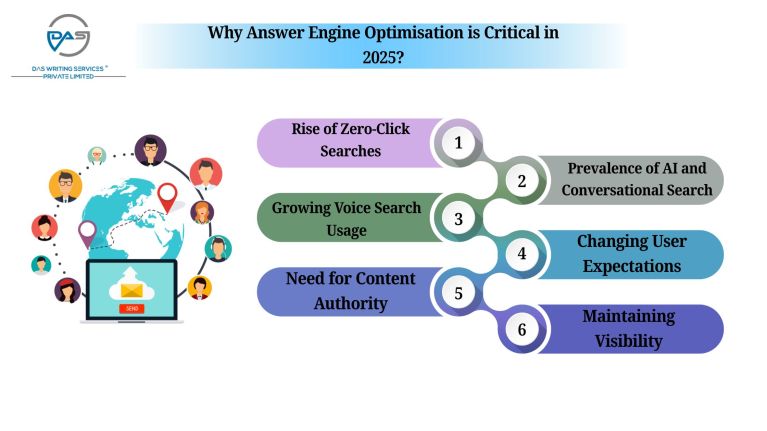
Rise of Zero-Click Searches
Almost 60% of global Google searches result in zero clicks, due to AI-induced search technologies. This means that users can access the information without having to click on any website.
Prevalence of AI and Conversational Search
Google provides direct answers to users through several tools, including Google Gemini, ChatGPT, and Bing CoPilot. Implementing AEO by SEO writers ensures your content is discoverable and cited by these platforms.
Growing Voice Search Usage
More than 65% of the Indian population utilises voice search, due to the use of a massive number of Android or iOS devices. To rank your content in the AI overview requires publishing concise and well-structured answers in a conversational tone.
Changing User Expectations
Users expect instant and accurate information while searching for any queries in Google. They are less likely to scroll through a list of links for simple queries. Thus, with the advancement of AEO and GEO techniques, users are getting the answers to their queries without clicking on any website.
Need for Content Authority
AI systems rely on well-researched, authoritative, and structured content to generate reliable answers. AEO and GEO implementation help structure content to meet these requirements.
Maintaining Visibility
Optimising your content for AEO can feature it in prominent positions like featured snippets or AI overview. It ensures your brand is visible even if users do not click through to your website.
How to Boost Your Content Visibility for AEO and GEO?
If you want to make your business visible in the AI overview, you can consult with B2B content writing companies to focus on these aspects:
-
Structure for AI-Induced Searches
Create “Answer First” Content: Begin articles with a direct, concise answer to the main question, followed by more detailed information.
Organise Logically: Use clear headings (H1, H2, and H3), short paragraphs, and bullet points to make content easy for AI to parse.
Format as Q&A: Directly format content to answer users' questions, mirroring how people ask questions to AI tools.
Build Authority and Trust
Demonstrate E-E-A-T: Emphasise Experience, Expertise, Authoritativeness, and Trustworthiness by backing up claims with data and linking to reputable sources.
Build Topical Authority: Publish consistent, in-depth coverage of a subject to establish your site as the go-to source for that particular topic.
Keep Updated Content: Regularly refresh content to ensure it contains the latest information, as AI models prefer fresh and relevant data.
Implement Technical Optimisations
Use Structured Data: Implement schema markup, such as FAQ, Article, and How-To, to provide context and make your content machine-readable for AI.
Write in Natural Language: Use a conversational tone, synonyms, and related terms to give the AI more context, which aligns with semantic SEO principles.
Optimise for Zero-Click Surfaces: Even without a user click, users can see your content in AI summaries, featured snippets, and “People Also Ask” boxes, so try to optimise your content for this visibility.
Monitor and Adapt the Trend
Track Performance: Use tools to monitor the performance of your content to optimise the content experience. This is because AI visibility requires a different kind of tracking than traditional organic rankings.
Iterate Based on Data: Continuously adjust your content based on performance data to stay relevant and visible in AI-driven search results.
How AEO and GEO Complement Each Other in Content Optimisation?
These are some key aspects that explain how AEO and GEO work together to enhance your content experience optimisation.
-
-
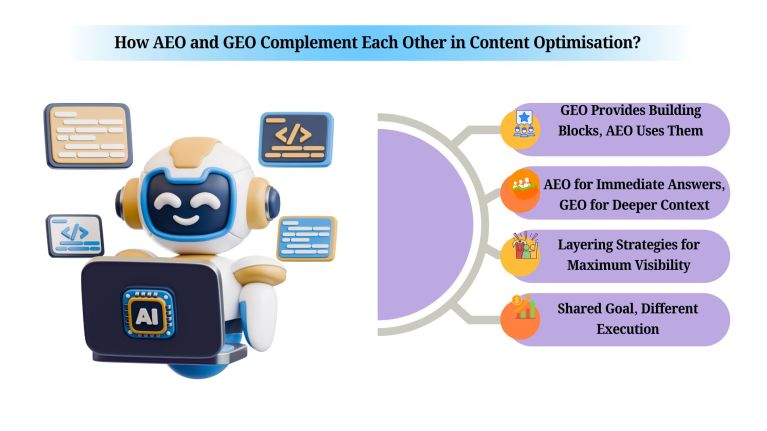
GEO Provides Building Blocks, AEO Uses Them
GEO ensures that AI models can find, understand, and cite your content as a trusted source of material. Whereas AEO takes it a step further as it optimises specific content for immediate delivery through direct answers.
AEO for Immediate Answers, GEO for Deeper Context
AEO is ideal to get answers to short, factual questions quickly for voice search and featured snippets. GEO helps your content get cited in more complex, research-based answers that require synthesising information from multiple sources.
Layering Strategies for Maximum Visibility
Traditional SEO gets your content discovered, and AEO helps it win direct answers. Conversely, GEO ensures that AI uses your content to generate new content. Thus, together these layers create a complete strategy for AI-driven search.
Shared Goal, Different Execution
Both AEO and GEO aim to surface your content in AI-driven search results. However, they achieve this through different means. AEO focuses on creating clear answers, while GEO focuses on building overall authority. Additionally, GEO focuses on making your content semantically rich so AI can synthesise it easily.
Final Words
The landscape of content optimisation is shifting from a sole focus on search engine rankings to a dual strategy that encompasses AEO and GEO. While traditional SEO remains foundational for digital visibility, AEO and GEO are the keys to future-proofing content in an AI-dominated world.






Join the Discussion