





















-
 +36 +1
How a Quarter of Cow DNA Came From Reptiles
By hopping between species, jumping genes have radically altered the course of animal evolution.
-
 +15 +1
A Few Bad Scientists Are Threatening to Topple Taxonomy
Naming species forms the foundation of biology—but these rogue researchers are exposing the flaws in the system
-
 +16 +1
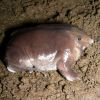
New Purple Pig-Nose Frog Found in Remote Mountains
Scientists have discovered a new and unusual species of frog in the Western Ghats mountain range in India. The frog has shiny, purple skin, a light blue ring around its eyes, and a pointy pig-nose. The scientists have called the new species Bhupathy's purple frog (Nasikabatrachus bhupathi), in honor of their colleague, Dr. Subramaniam Bhupathy, a respected herpetologist who lost his life in the Western Ghats in 2014.
-
 +20 +1
Curious Kids: How do snakes make an 'sssssss' sound with their tongue poking out?
The way humans make an 'ssss' noise is different to the way a snake does it. We put our tongue behind our teeth when we hiss, but for a snake the tongue isn't involved at all in making sounds.
-
 +17 +1
Snake infrared detection unraveled :
The pit organ is part of the snake's somatosensory system — which detects touch, temperature and pain — and does not receive signals from the eyes, confirming that snakes 'see' infrared by detecting heat, not photons of light.
-
 +31 +1
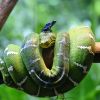
Strange Places to Sit
A poison frog sits on top of an emerald tree boa in its enclosure at the Singapore Zoo's new Reptopia exhibit.
-
 +23 +1
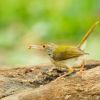
Birds, Bees and other Critters have Scruples, and for Good Reason
Humans are not the only species to show a strong work ethic and scruples. Researchers have found evidence of conscientiousness in insects, reptiles, birds, fish and other critters, such as working hard, paying attention to detail and striving to do the right thing.
-
 +11 +1
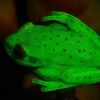
The world’s first glow-in-the-dark frog found in Argentina
Scientists in Argentina have discovered a frog that glows in moonlight and at twilight. Fluorescence in terrestrial environments had previously only been traced to a few species of insects and birds and had never been scientifically reported in any of the world’s 7,000-plus amphibian species. A team of herpetologists made the headline-grabbing discovery in the outskirts of the city of Santa Fe, Argentina, while collecting frogs to research the biochemical cloricia in amphibians.
-
 +26 +1
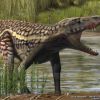
Unknown Ancient Reptile Roamed the Pyrenees Mountains
The footprint made by a reptile that lived almost 250 million years ago has been found in the Pyrenees.
-
 +22 +1
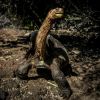
Meet Diego, the Centenarian Whose Sex Drive Saved His Species
By fathering hundreds, a giant tortoise in the Galápagos Islands reversed the threat of extinction. Another, earning the name Lonesome George, was unable to do the same.
-
 +25 +1
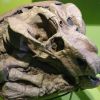
What our ancestors’ third eye reveals about the evolution of mammals to warm blood
French philosopher René Descartes believed that the pineal gland, a tiny button of neurons located in the depth of our brain, was the seat of the soul. By Julien Benoit.
-
 +5 +1
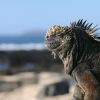
+5 +1Watch a Baby Iguana Run for Its Life From a Terrifying Pit of Snakes
Hold onto your butts because this scene from the new Planet Earth II will have you leaping off your seat. By Sarah Emerson.
-
 +13 +1
Tree frog named 'Toughie', last known member of his species, dies in Atlanta
The last known member of a rare tree frog species has died at the Atlanta Botanical Garden in Georgia. The Rabbs’ fringe-limbed tree frog was known to staff at the Garden as “Toughie” and believed to be approximately 12 years old. His body was found in his enclosure last week during a routine daily inspection, the Atlanta Journal-Constitution reported.
-
 +19 +2
A tortoise had so much sex that he's 'saved his entire species'
Several animals have gone extinct in the last decade – including the Baiji dolphin, the Spix’s macaw, the Liverpool Pigeon and the West African black rhino. One animal which has been pulled back from extinction however, is a species of Galapagos giant tortoise - thanks to the sexual exploits of just one male. Diego is over 100 years old and has fathered some 800 offspring.
-
 +38 +2
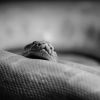
‘Ghost Snake’ Discovered in Madagascar
Researchers discovered a new snake species in Madagascar and named it “ghost snake” for its pale grey coloration and elusiveness. They found the ghost snake on a recently opened path within the well-traveled Ankarana National Park in northern Madagascar in February 2014. They studied the snake’s physical characteristics and genetics, which verified that it is a new species.
-
 +12 +2
How Sulcata Tortoises Became America's Most Adorable Mistake
Over the last three decades, massive sulcata tortoises have become a popular American family pet. Meet the people who made that happen — and the ones that are begging you not to buy one.
-
 +8 +2
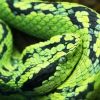
+8 +2New venomous snake species discovered in Costa Rica
A group of researchers from the U.S. and Costa Rica announced this week the discovery of a new species of venomous snake in the mountains of Costa Rica that they’re calling the Talamancan palm-pitviper (Bothriechis nubestris). Researchers from the University of Central Florida (UCF) and the University of Costa Rica (UCR) discovered the snake in the cloud forests of the Talamanca mountain range, which runs through most of Costa Rica and northern Panama. Their research is published in the July 15 online issue of the journal Zootaxa.
-
 +9 +1
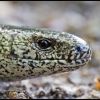
+9 +1Lizard
This slow worm was just looking at me and staying relaxed while I took a couple of pictures. More pictures at my site. It was about the length of an underarm and was no thicker than a little finger of a man.
-
 +14 +1
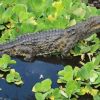
Florida crocodiles: Man-eating Nile beasts confirmed in swamps
DNA tests have confirmed that three man-eating Nile crocodiles have been found living in Florida's swamps. Unlike local alligators, the species preys on humans and is thought to be responsible for up to 200 deaths a year at home in sub-Saharan Africa. It is possible more of the beasts are at large in the state, experts say. It is not known for certain how they reached the US. "They didn't swim from Africa," said University of Florida herpetologist Kenneth Krysko.
-
 +32 +2
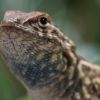
These Lizards Have Been Playing Rock-Paper-Scissors for 15 Million Years
Male side-blotched lizards have more than one way to get the girl. Orange males are bullies. Yellows are sneaks. Blues team up with a buddy to protect their territories. Who wins? It depends - on a genetic game of roshambo.
Submit a link
Start a discussion