


















-
 +21 +3
Elemental Burning
-
 +17 +4
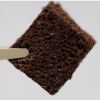
Coffee-infused foam removes lead from contaminated water
Coffee is one of the most popular drinks in the U.S., which makes for a perky population — but it also creates a lot of used grounds. Scientists now report in the journal ACS Sustainable Chemistry & Engineering an innovative way to reduce this waste and help address another environmental problem. They have incorporated spent coffee grounds in a foam filter that can remove harmful lead and mercury from water.
-
 +33 +12
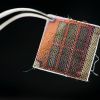
A Chemist and a Designer Team Up to Weave Solar Panels Into Fabric
Trisha Andrew and Marianne Fairbanks are developing a solar textile that could end up in clothing, curtains, car seats and tents
-
 +26 +10
Will the Periodic Table Ever Be Complete?
Recently, humanity filled the periodic table up to atomic number 118, which nicely rounds out that row. But are we done yet? Have we discovered all of the different elements? And what is an "island of stability?"
-
 +31 +8
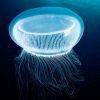
Fluorescent jellyfish proteins light up unconventional laser
Molecules derived from jellyfish may lead to a new generation of energetically efficient lasers that could improve everything from communications to medical procedures
-
 +19 +6
Paper-Based Microbial Fuel Cell Operates without External Power
The paper-based MFC runs for five consecutive days and shows the production of electrical current as a result of biofilm formation on the anode. The system produces 1.3 μW of power and 52.25 μA of current yielding a power density of around 25 W/m3 for the experiment. The results show that the paper-based microbial fuel cells can create power in an environmentally friendly mode without the use of any external power sources. Nastaran Hashemi, Assistant Professor of Mechanical Engineering and the senior author of the paper...
-
 +16 +4
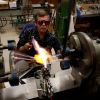
Caltech glassblower's retirement has scientists sighing
Hunkered down in the sub-basement of the Norman W. Church Laboratory for Chemical Biology, underneath a campus humming with quantum teleportation devices, gravity wave detectors and neural prosthetics, Rick Gerhart chipped away at a broken flask. Blowtorch in hand, he pulled the softened glass apart like taffy, tweezing out glass shards with a flick of his wrist. Peering into the dancing flames, he examined his work for wrinkles — imperfections invisible to the untrained eye.
-
 +6 +1
+6 +1Chemists Discover New Way to Turn Plastic into Usable Fuel
Researchers from the University of California, Irvine and the Shanghai Institute of Organic Chemistry (or SIOC) in China have found a new way to go about recycling millions of tons of plastic garbage into liquid fuel. UCI chemist Zhibin Guan says synthetic plastics are a fundamental part of modern life, but our use of them …
-
 +16 +2
Watch Liquid Nitrogen White Walkerize a Watermelon
You've seen it on fancy cooking shows and in night clubs, but here's how household objects behave after taking a polar dip into liquid nitrogen.
-
 +33 +7
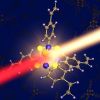
German scientists have developed a compound that can transform infrared into warm, white-colored light.
A team of scientists in Germany has developed a compound that can transform infrared into warm, white-colored light. The team, headed by Dr. Nils Wilhelm Rosemann of the Philipps-Universität Marburg, designed their compound of tin and sulfur, and with a diamondoid-like structure, then coating this scaffolding with organic ligands.
-
 +18 +4
‘Chemophobia’ is irrational, harmful – and hard to break
The level of formaldehyde in a vaccine is 80 times less than in a single pear, yet this is one instance where the reflexive rejection of chemicals is particularly dangerous. On chemophobia, and why 'natural' does not necessarily mean 'safe'.
-
 +45 +10
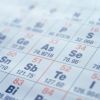
Four New Elements Get Names
The groups responsible for the discovery of these new elements each put forward their proposed name and symbol after Iupac confirmed their existence in January 2016. The criteria states an element may be named after a mythological figure or concept, geological place, scientist, elemental property, or mineral.
-
 +35 +5
How a chemist at Yale found a whole new way to take on cancer
By hijacking tiny cellular garbage trucks to seek and destroy malignant cells.
-
 +20 +2
10 Surprising Chemicals Your Body Makes
Everything is made of chemicals, including the human body, but there are some especially weird ones...
-
 +27 +6
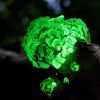
Cracking the mushroom glow mystery
A Japanese researcher believes he has solved part of the puzzle of fungal bioluminescence
-
 +21 +5
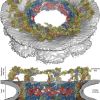
Biochemists solve the structure of cell's DNA gatekeeper
Caltech scientists have produced the most detailed map yet of the massive protein machine that controls access to the DNA-containing heart of the cell.
-
 +29 +7
Why Does Water Go Stale Overnight?
You’re going to bed, and you take a sip of cool delicious water, and it’s so refreshing. But, when you wake up and take a swig, that water now tastes like bleh. What’s going on here? Watch this SciShow Quick Question to find out!
-
 +44 +9
Scientists Think They've Figured Out Why Van Gogh's Sunflowers Are Fading
The vibrant colors of many of Vincent van Gogh’s most famous paintings—including his Sunflower series—have been fading over the last 100 years. Now a team of Italian scientists has come up with an explanation as to why the lead chromate dyes favored by the artist when mixing his pigments degrade so much under light. They described their work in a new paper in Chemical Science.
-
 +28 +6
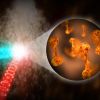
World’s fastest electron diffraction snapshots of atomic motions in gases
Scientists have made a significant advance toward making movies of extremely fast atomic processes with potential applications in energy production, chemistry, medicine, materials science and more. Using a superfast, high-resolution “electron camera,” a new instrument for ultrafast electron diffraction...
-
 +21 +2
Cosmic Nucleosynthesis | Space Time | PBS Digital Studios
Joni Mitchell was right, we are stardust.
Submit a link
Start a discussion