





















-
 +21 +1
Egypt's newly discovered tombs hold mummies, animal statues
A top Egyptian antiquities official says local archaeologists have discovered seven Pharaonic Age tombs near the capital Cairo containing dozens of cat mummies along with wooden statues depicting other animals and birds.
-
 +16 +1
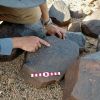
A New History of Arabia, Written in Stone
How strange rocks—and an obscure language—are changing a decades-old academic consensus.
-
 +3 +1
+3 +1Archaeologists discover oldest olive groves in Croatia dating 3,500 years
Archaeologists from Zadar have come across a variety of finds dating back to the Middle Bronze Age in the sea between the Isle of Ricul in the Pasman Channel and the coastal resort of Turanj, including numerous 3,500-years-old olive pits, which speak to the oldest olive groves along Croatia’s Adriatic. In northern Dalmatia, little was known about the Middle Bronze Age until archaeologists began underwater explorations several years ago.
-
 +14 +1
How Men Stole Civilization
Civilization is back. But it is no longer the preserve of “Renaissance man” or of “the West,” or even of literate societies. Civilization is a way of talking about human history on the largest scale. From the cave paintings of Lascaux to the latest MoMA exhibition, it binds human history together.
-
 +18 +1
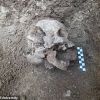
Archaeologists discover remains of 'vampire' child buried in cemetery
The grave of a 'vampire child' buried more than 2,000 years ago has been excavated by stunned archaeologists who found the body had been weighed down, over fears it would rise from the dead. Evidence of a ritualistic burial was found deep underground when a team in Rome, Italy, dug up the remains of a child aged 10, which had a stone placed in its mouth.
-
 +1 +1
+1 +1The World’s Oldest Dress
This Tarkhan dress was found in an Egyptian tomb.
-
 +17 +1
Eight-year-old Swedish-American girl pulls pre-Viking era sword from lake
"It's not every day that one steps on a sword in the lake!" Mikael Nordström from Jönköpings Läns Museum said when explaining the significance of the find. But that's exactly what happened to Saga Vanecek, who found the relic at the Vidöstern lake in Tånnö, Småland earlier this summer. "I was outside in the water, throwing sticks and stones and stuff to see how far they skip, and then I found some kind of stick," Saga told The Local.
-
 +2 +1
+2 +1A year of unprecedented archaeological findings in Saudi Arabia
Saudi Arabia has concluded the past Hijri (Islamic calendar) year with unprecedented archaeological findings, as well as achievements in archaeological protection, rehabilitation of sites and restoration of national antiquities. The recent discovery of the 85,000-year-old remains of an ancient man in the Nefud Desert on the outskirts of Tabuk was considered among the most important discoveries announced by the Saudi Commission for Tourism and Heritage (SCTH) this year.
-
 +31 +1
Neanderthals Hand Structures
According to the study, the hands of the Neanderthals, in contrast to the predicted, were too curvy to hold objects between the thumb and the other fingers. The Neanderthals could hold objects between the thumb and the other fingers, just as we would hold our pencil, because their hands were much more curved than they thought. The finding helps explain the activities that require a large number of skills, such as the Neandertals, tool making, painting cave walls, drawing patterns on the bird’s bones, and twine.
-
 +11 +1
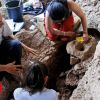
Fancy a 13,000-year-old beer, anyone?
Researchers believe they have found the world's oldest brewery in a prehistoric cave in Israel.
-
 +2 +1
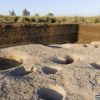
+2 +1Ancient village found in Egypt predates time of pharaohs
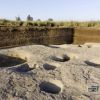
Archaeologists believe they have unearthed one of Egypt's oldest-known settlements in the Nile Delta, dating back some 7,000 years to the Neolithic era. The country's ministry of antiquities announced the discovery of a village in the Tell el-Samara area of the Dakahlia governorate, north of Cairo, in a statement posted to Facebook on Sunday.
-
 +4 +1
+4 +1Archaeologists uncover one of oldest villages ever found in Nile Delta, Egypt
Egypt says archaeologists have unearthed one of the oldest villages ever found in the Nile Delta, with remains dating back to before the pharaohs. The Antiquities Ministry said Sunday the Neolithic site was discovered in Tell el-Samara, about 140 kilometres north of Cairo. Chief archaeologist Frederic Gio says his team found silos containing animal bones and food, indicating human habitation as early as 5,000 B.C.
-
 +21 +1
Oldest surviving Maya book declared authentic
Fifty-four years after it was sold by looters, an ancient Maya pictographic text was judged authentic by scholars Thursday. Mexico's National Institute of History and Anthropology said the calendar-style text was made between 1021 and 1154 A.D. and is the oldest known pre-Hispanic document. The 10 surviving pages of the tree-bark folding "book" will now be known as the Mexico Maya Codex. It had been known as the Grolier Codex.
-
 +30 +1
DNA shows cave girl was half Neanderthal
Once upon a time, two early humans of different ancestry met at a cave in Russia. Some 50,000 years later, scientists have confirmed that they had a daughter together. DNA extracted from bone fragments found in the cave show the girl was the offspring of a Neanderthal mother and a Denisovan father.
-
 +11 +1
700,000-Year-Old Stone Tools Point to Mysterious Human Relative
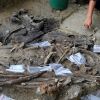
Stone tools found in the Philippines predate the arrival of modern humans to the islands by roughly 600,000 years—but researchers aren’t sure who made them. The eye-popping artifacts, unveiled on Wednesday in Nature, were abandoned on a river floodplain on the island of Luzon beside the butchered carcass of a rhinoceros. The ancient toolmakers were clearly angling for a meal. Two of the rhino's limb bones are smashed in, as if someone was trying to harvest and eat the marrow inside. Cut marks left behind by stone blades crisscross the rhino's ribs and ankle, a clear sign that someone used tools to strip the carcass of meat.
-
 +16 +1
Evidence in the bones reveals rickets in Roman times
Rickets is mostly seen as a 19th-century disease, but research has revealed that the Romans also had a big problem with getting enough vitamin D. Researchers from Historic England and McMaster University in Canada examined 2,787 skeletons from 18 cemeteries across the Roman empire and discovered that rickets was a widespread phenomenon 2,000 years ago.
-
 +12 +1
'Oldest solid cheese ever found’ discovered in Egyptian jar
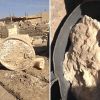
For thousands of years beneath Egypt’s desert sands a solidified whitish substance sat in a broken jar. Scientists now say it’s “probably the most ancient archaeological solid residue of cheese ever found.” Archaeologists came across the finding while cleaning the sands around a 19th-dynasty tomb at the vast Saqqara necropolis of the ancient city of Memphis. The tomb of Ptahmes, the mayor of ancient Memphis, was initially discovered in 1885 but had been swallowed by shifting sands until its rediscovery in 2010.
-
 +13 +1
Homo erectus were too short-sighted and lazy to survive, research finds
It may have been a lazy, 'why bother?' attitude that led to the downfall of an early species of human, according to new research. Findings from the Australian National University after an archaeological excavation in Saudi Arabia found Homo erectus tended to do the bare minimum to get by, while other species of human were inclined to put in the effort. They used "least-effort strategies" for tool making and collection of resources, as opposed to Homo sapiens and Neanderthals, who would climb mountains and haul materials over dozens of kilometres to ensure they had quality goods, the research showed.
-
 +1 +1
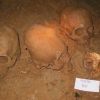
+1 +1Mexican archeologists find 7,000-year-old Mayan remains in cave
Archeologists in Mexico have discovered sets of human remains from the early ancestors of the Mayan civilization that could be as much as 7,000 years old, officials reported on Tuesday. According to archaeologists at a Mexico City news conference, three sets of human remains were unearthed at the Puyil cave in the Tacotalpa municipality of Tabasco state, located in southern Mexico.
-
 +10 +1
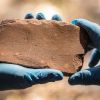
Aboriginal archaeological discovery in Kakadu rewrites the history of Australia
Aboriginal people have lived in Australia for a minimum of 65,000 years, a team of archaeologists has established - 18,000 years longer than had been proved previously and at least 5000 years longer than had been speculated by the most optimistic researchers. The world-first finding, which follows years of archaeological digging in an ancient camp-site beneath a sandstone rock shelter within the Jabiluka mining lease in Kakadu, Northern Territory...
Submit a link
Start a discussion