




















-
 +17 +3
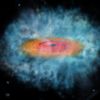
Did Supermassive Black Holes Collapse Directly out of Giant Clouds of gas? It Could Depend on Magnetic Fields
Roughly half a century ago, astronomers realized that the powerful radio source coming from the center of our galaxy (Sagitarrius A*) was a “monster” black hole. Since then, they have found that supermassive black holes (SMBHs) reside at the center of most massive galaxies. This leads to what is known as Active Galactic Nuclei (AGN) or quasars, where the central region of a galaxy is so energetic that it outshines all of the stars in its galactic disk. In all that time, astronomers have puzzled over how these behemoths (which play a crucial role in galactic evolution) originated.
-
 +3 +1
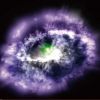
+3 +1New Flash Of Deep Space Could Be Massive Star Explosion
Scientists have discovered an ultra-bright phenomenon in the distant universe that could have come from a star destroyed by a black hole. The fleeting phenomenon evolves much faster than a supernova but is just as bright as the massive star explosion.
-
 +22 +4
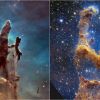
Webb Telescope Shows the Pillars of Creation Like You’ve Never Seen Them Before
The famous clouds of gas and dust are dazzling in the state-of-the-art instrument’s eye.
-
 +14 +5
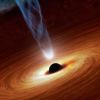
A black hole collision just proved Albert Einstein’s theory as correct
A first-time observed collision between a pair of black holes, which was 10 billion times faster than previous observations, has proven Albert Einstein’s theory as correct. The pair of black holes orbit each other, getting rid of the gravitational waves as they rotate closer to one another. However, as in the case of the precession, Einstein’s theory of general relativity indicates the way black holes can affect the precession or movement. Einstein also predicted gravitational waves in 1916 in his theory.
-
 +14 +3
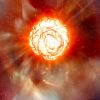
Red Alert: Massive stars sound warning they are about to go supernova
Astronomers from Liverpool John Moores University and the University of Montpellier have devised an 'early warning' system to sound the alert when a massive star is about to end its life in a supernova explosion. The work was published in Monthly Notices of the Royal Astronomical Society.
-
 +14 +2
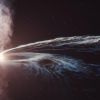
‘We’ve Never Seen Anything Like This Before:’ Black Hole Spews Out Material Years After Shredding Star
In October 2018, a small star was ripped to shreds when it wandered too close to a black hole in a galaxy located 665 million light years away from Earth. Though it may sound thrilling, the event did not come as a surprise to astronomers who occasionally witness these violent incidents while scanning the night sky.
-
 +19 +1
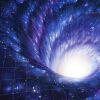
What are wormholes? An astrophysicist explains these shortcuts through space-time
A wormhole is like a tunnel between two distant points in our universe that cuts the travel time from one point to the other. Imagine two towns on two opposite sides of a mountain. People from these towns would probably have to travel all the way around the mountain to visit one another. But, if they wanted to get there faster, they could dig a tunnel straight through the mountain to create a shortcut. That's the idea behind a wormhole.
-
 +19 +3
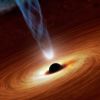
Do black holes explode?
Black holes are cosmic vacuum cleaners — massive objects so large that not even light can escape them. Most people imagine black holes do nothing but sit there and devour wandering pieces of gas or dust.
-
 +4 +1
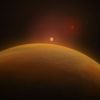
+4 +1Discovery of alien world with strange, tilted orbit puzzles astronomers
The orbit of an exoplanet around a star in a binary star system has been portrayed in three dimensions for the first time. The planet orbits its star at a different angle to the plane of the orbit of the two stars, and the misalignment could offer clues as to how planets form in binary systems.
-
 +18 +3
Frank Drake, astronomer famed for contributions to SETI, has died
The equation named after him helps organize our thoughts on extraterrestrial life. On Friday, the family of astronomer Frank Drake announced that he passed away peacefully at 92 in his California home, near the site of his final academic position at the University of California, Santa Cruz. Drake made a number of contributions to radio astronomy, including serving as director of the Arecibo radio telescope facility.
-
 +4 +1
+4 +1Cosmic 'tug-of-war' between galaxies created a tidal tail of whipped-away stars
A distant galaxy stopped birthing stars when a merger with another galaxy ripped out its star-forming gas and stars, a violent process that left it with a massive 'tail' of star-stuff. SDSS J1448+1010 was formed when the universe was roughly half its current age of 13.8 billion years old from the collision of two progenitor galaxies. This resulted in a cosmic tug of war arising from each galaxy's gravitational influence.
-
 +14 +4
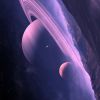
NASA scientists have discovered stars that are cool enough to touch.
Last year, NASA announced that it had discovered 14 of the coldest stars it had ever recorded. The so-called “brown dwarfs” were, at that time, listed among the coldest known stars in our universe.
-
 +13 +1
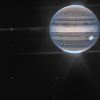
‘Incredible’ Jupiter images revealed by NASA’s James Webb telescope
Stunning images taken by NASA’s James Webb Space Telescope show Jupiter in new glory. Fifth in line from the sun, Jupiter is the largest planet in our solar system — more than twice as big as all the others combined. If Earth were the size of a grape, Jupiter would be the size of a basketball, NASA says.
-
 +20 +3
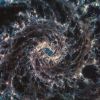
You've seen some spectacular James Webb telescope images — but you haven't seen this one
The adolescent phase of the universe was much more complex than imagined, detailed snapshots of the early cosmos from the James Webb Space Telescope (JWST) reveal. "There are many more galaxies with obvious disks, bulges, spiral arms … appearing earlier in cosmic time than we thought," Karl Glazebrook says.
-
 +12 +1
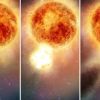
Scientists left stumped after massive never-before-seen eruption rips through star
The red supergiant Betelgeuse, a colossal star in the Orion constellation, experienced a massive stellar eruption - the likes of which have never been seen before, according to astronomers. Betelgeuse first drew attention in late 2019 when the star, which glitters like a red gem in the upper-right shoulder of Orion, experienced an unexpected darkening. The supergiant continued to grow dim in 2020.
-
 +21 +3
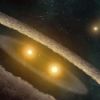
Scientists Discover 'First of Its Kind' 3-Star System in Deep Space
Somewhere in the depths of our universe, a stellar ballet is underway. Against the dark curtain of space, three enormous, glittering stars are locked in a dance by their own gravitational forces and aglow in their shared luminescence. Two blazing balls of gas are tightly pirouetting around each other, completing their mutual orbit to the rhythm of an Earth day. Simultaneously, a third star steadily encircles the pair, casting a spotlight on the performance.
-
 +20 +1
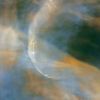
Hubble's Closeup of The Orion Nebula Looks Like a Surreal Dreamscape
One of the most beautiful and spectacular regions of the night sky can be found in the constellation of Orion.
-
 +26 +6
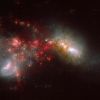
JWST has caught two galaxies smashing together and sparking starbursts
The James Webb Space Telescope (JWST) has caught two galaxies colliding. In the midst of this cosmic clash, researchers have found something unexpected – there doesn’t seem to be an active supermassive black hole in either galaxy. The pair of galaxies, called IC 1623 or VV 114, is about 275 million light years away in the direction of the constellation Cetus. Lee Armus at the California Institute of Technology and his colleagues observed them with JWST as part of a campaign to spot four relatively nearby, bright galaxy mergers and figure out how they work.
-
 +13 +2
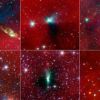
Astronomers witness the rare break up of a star couple
Astronomers have witnessed a rare and important life event in the evolution of binary star couplings for the first time. The team discovered a tight binary star surrounded by an expanding shell of material. This shell is matter is leftover from a stage in the stars' evolution called the common envelope phase.
-
 +14 +3
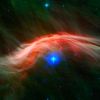
A Fast-Moving Star is Colliding With Interstellar gas, Creating a Spectacular bow Shock
Zeta Ophiuchi has had an interesting life. It began as a typical large star about twenty times more massive than the Sun. It spent its days happily orbiting a large companion star until its companion exploded as a supernova about a million years ago. The explosion ejected Zeta Ophiuchi, so now it is speeding away through interstellar space. Of course, the supernova also expelled the outer layers of the companion star, so rather than empty space...
Submit a link
Start a discussion