



















-
 +4 +1
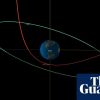
+4 +1Asteroid 2023 BU about to pass Earth in one of closest ever encounters
No danger, says Nasa, from delivery truck-sized asteroid that was discovered on Saturday and will pass lower than communication satellites
-
 +26 +2
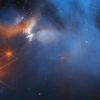
James Webb Space Telescope discovers coldest interstellar ice ever seen
Using the James Webb Space Telescope, astronomers discover a rich catalog of frigid interstellar ice in the depths of a dark, dense molecular cloud.
-
 +12 +2
NASA and DARPA will build a nuclear rocket by 2027
The agency wants the technology for use in crewed missions to Mars.
-
 +13 +3
Walter Alter: Webb Telescope Big Bangs Experts
Since July 2022, the James Webb Space Telescope has delivered stunning news: it's seeing galaxies orders of magnitude brighter in the early universe then what science anticipated.
-
 +2 +1
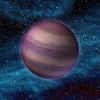
+2 +1Binary Dwarf Stars Found Orbiting Each Other Every 20 Hours. They Were Once Almost Touching
A team of astrophysicists has discovered a binary pair of ultra-cool dwarfs so close together that they look like a single star. They’re remarkable because they only take 20.5 hours to orbit each other, meaning their year is less than one Earth Day. They’re also much older than similar systems.
-
 +28 +6
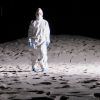
Japan astronaut applicants take final exam on mock lunar surface
Aspiring Japanese astronauts have taken their final exams on a mock lunar surface at a training facility near Tokyo, with the successful candidates to be revealed next month.
-
 +15 +4
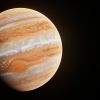
Scientists offer a new explanation for a mystery surrounding Jupiter's two massive asteroid swarms
An international team of scientists, including NYU Abu Dhabi researcher Nikolaos Georgakarakos and others from the U.S., Japan, and China, led by Jian Li from Nanjing University, has developed new insights that may explain the numerical asymmetry of the L4 and L5 Jupiter Trojan swarms, two clusters containing more than 10,000 asteroids that move along Jupiter's orbital path around the sun.
-
 +15 +6
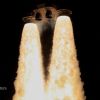
2022 was a record year for space launches
180 rockets lifted off successfully, with SpaceX driving the pace.
-
 +14 +1
Wild space 'ferry' concept uses paragliders to return satellites and science to Earth
Outpost recently tested a stratospheric paraglider to return space tech ahead of orbital ventures for NASA and other companies later in the 2020s.
-
 +3 +1
+3 +1Every planet in the solar system visible in rare "planet parade" Wednesday
The astronomical phenomenon gave skywatchers a good view of Mercury, Venus, Mars, Jupiter and Saturn with the naked eye.
-
 +25 +2
Is the Milky Way... Normal?
Studying the large-scale structure of our galaxy isn’t easy. We don’t have a clear view of the Milky Way’s shape and features like we do of other galaxies, largely because we live within it. But we do have some advantages. From within, we’re able to carry out close-up surveys of the Milky Way’s stellar population … Continue reading "Is the Milky Way… Normal?"
-
 +16 +3
Are Planets Tidally Locked to Red Dwarfs Habitable? It's Complicated
A new study shows that some tidally-locked explanets around red dwarf stars could be partly habitable. But the land-ocean ratio is critical.
-
 +12 +1
NASA captures a "snapshot in time" showing how a star is born among the Cosmic Cliffs
NASA was able to capture a "gallery of objects ranging from small fountains to burbling behemoths" deep in space: "It's like finding buried treasure."
-
 +3 +1
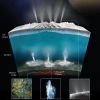
+3 +1What it would take to discover life on Saturn's icy moon Enceladus
Surrounded by a vast ocean underneath a thick ice shell, Enceladus is a hot candidate for potentially harboring alien life. A team of researchers led by the University of Arizona concluded that a future mission could provide answers even without landing on the tiny world.
-
 +22 +4
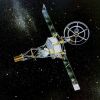
60 years ago today, a spacecraft zipped past planet Venus for the 1st time ever
Human-built spacecraft have been exploring other planets for a full 60 years. On Dec. 14, 1962, a NASA spacecraft called Mariner 2 flew past Venus in the first-ever planetary flyby. The maneuver gave the spacecraft 42 minutes to observe what scientists now consider Earth's hellish twin — whose hidden surface at the time was thought to be lush, tropical jungle or swamp.
-
 +13 +1
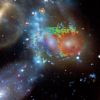
UK-led robotic sky scanner reveals its first galactic fingerprint
A major telescope upgrade has peered through to the distant Universe to reveal the spectra of a pair of galaxies 280 million light years away from Earth.
-
 +14 +2
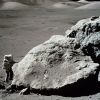
50 years since the last Apollo astronauts went to the moon, NASA is finally going back
December 7, 1972 was the launch of the final mission in NASA's Apollo moon program. Fifty years later, NASA finally seems poised to return people to the lunar surface.
-
 +16 +1
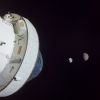
After the Artemis I mission’s brilliant success, why is an encore 2 years away?
"I would say that we’re going to try our best to get there."
-
 +4 +1
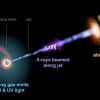
+4 +1Astronomers capture black hole gobbling up a star in a “hyper-feeding frenzy”
“It’s probably swallowing the star at the rate of half the mass of the Sun per year.”
-
 +18 +4
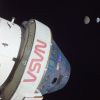
Orion flies far beyond the Moon, returns an instantly iconic photo
"It’s really hard to articulate what the feeling is."
Submit a link
Start a discussion