



















-
 +27 +1
Here's proof that Russian-backed accounts pushed the Nike boycott
Pro and anti-Donald Trump groups dominated the online boycott against Nike's Colin Kaepernick advertisements – but suspected Russian accounts were also involved. Since 2016, the eyes of the world have been on Colin Kaepernick. And, it turns out, so have the eyes of Russia's disinformation machine. On August 14, 2016, American footballer Colin Kaepernick missed the San Francisco 49ers' first pre-season match against the Houston Texans, suffering from arm fatigue.
-
 +7 +1
+7 +1Facebook, Google agree to tackle fake news: EU
Facebook (FB.O), Google (GOOGL.O) and other tech firms have agreed a code of conduct to do more to tackle the spread of fake news, due to concerns it can influence elections, the European Commission said on Wednesday. Intended to stave off more heavy-handed legislation, the voluntary code covers closer scrutiny of advertising on accounts and websites where fake news appears, and working with fact checkers to filter it out, the Commission said.
-
 +32 +1
How the Facebook right-wing propaganda machine works
On Facebook, right-wing meme pages play a vital role in condensing and recycling far-right talking points and keeping the MAGA base engaged online.
-
 +13 +1
Fake news a democratic crisis, MPs warn
The UK faces a "democratic crisis" with voters being targeted with "pernicious views" and data being manipulated, a parliamentary committee is set to warn. The Digital, Culture, Media and Sport (DCMS) Committee has been investigating disinformation and fake news following the Cambridge Analytica data scandal. In its first report, MPs will suggest social media companies should face tougher regulation or a new tax.
-
 +31 +1
What YouTube could teach Facebook about conspiracies
Context cards could help Facebook fight misinformation
-
 +24 +1
The 'Guerrilla' Wikipedia Editors Who Combat Conspiracy Theories
Susan Gerbic's team of over 100 editors are responsible for some of Wikipedia’s most trafficked pages about UFOs and other pseudoscience.
-
 +32 +1
Germany sees sharp rise in 'fake science' journal publications
Thousands of German scientists — many using public funds — have published their results in quasi-scientific journals without being peer reviewed, according to a report
-
 +9 +1
+9 +1Fake, misleading social media posts exploding globally, Oxford study finds
Russia’s social media blitz to influence the 2016 U.S. election was part of a global “phenomenon” in which a broad spectrum of governments and political parties used Internet platforms to spread junk news and disinformation in at least 48 countries last year, an Oxford University study has found. Including U.S. government programs aimed at countering extremists such as Islamic fundamentalists, about $500 million has been spent worldwide on research, development or implementation of social media “psychological operations” since 2010, the authors estimated.
-
 +14 +1
Facebook will not remove fake news
Facebook says it will not remove fake news from its platform because it does not violate its community standards. The social network is currently running an advertising campaign in the UK that declares "fake news is not our friend". But it said publishers often had "very different points of view" and removing fabricated posts would be "contrary to the basic principles of free speech". Instead, it says posts that it deems to be fake news will be "demoted" in the news feed.
-
 +9 +1
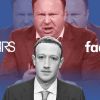
+9 +1Facebook won't ban Infowars in its fake-news purge — a site that says 9/11 was staged and the moon landing was fake
Facebook on Wednesday drew scrutiny for allowing the conspiracy-theory website Infowars to operate a page on its platform just as the social network was trying to promote its efforts in dealing with intentionally false or misleading news.
-
 +29 +1
Facebook Says InfoWars, Which Reported That NASA Has a Slave Colony on Mars, Is a Valid Source of “Opinion and Analysis”
Gotta hear both sides (of the Martian NASA-slavery debate).
-
 +16 +1
Susceptibility to fake news is driven more by lazy thinking than partisan bias
The spread of fake news may have less to do with ideological blinders and more to do with a lack of thinking, according to new research published in the journal Cognition. The two-part study of 3,446 participants found that more analytic people were less likely to believe fake news headlines than less analytic people, regardless of partisan bias.
-
 +18 +1
We read every one of the 3,517 Facebook ads bought by Russians. Here's what we found
The Russian company charged with orchestrating a wide-ranging effort to meddle in the 2016 presidential election overwhelmingly focused its barrage of social media advertising on what is arguably America’s rawest political division: race. The roughly 3,500 Facebook ads were created by the Russian-based Internet Research Agency, which is at the center of Special Counsel Robert Mueller’s February indictment of 13 Russians and three companies seeking to influence the election.
-
 +25 +1
Alexander Nix blames 'global liberal media' for Cambridge Analytica collapse
Former CEO of company at the centre of the Facebook data-mining scandal is appearing before the Commons ‘fake news’ inquiry.
-
 +21 +1
France's fake news law leaves media experts uneasy
France is the latest country attempting to fight the scourge of fake news with legislation -- but opponents say the law won't work and could even be used to silence critics.
-
 +15 +1
21 journalists in six countries jailed on charges related to 'fake news' in 2017
A minimum of 21 journalists worldwide were imprisoned on charges connected to "fake news" last year, according to a new report from the Committee to Protect Journalists. The report cites the recent implementation of measures in countries such as Brazil, the Philippines, Singapore, Malaysia and Russia aimed at targeting the rise of fake news. Arrests blamed on fake news reportedly more than doubled from 2016.
-
 +12 +1
What Advertising History Says About the Future of Fake News
Technological advances have made it easy to spread fake news. But after these fabrications become familiar, their danger is likely to recede, the economist Austan Goolsbee says.
-
 +7 +1
+7 +1We read every one of the 3,517 Facebook ads bought by Russians. Their dominant strategy: Sowing racial discord
The Russian company charged with orchestrating a wide-ranging effort to meddle in the 2016 presidential election overwhelmingly focused its barrage of social media advertising on what is arguably America’s rawest political division: race. The roughly 3,500 Facebook ads were created by the Russian-based Internet Research Agency, which is at the center of Special Counsel Robert Mueller’s February indictment of 13 Russians and three companies seeking to influence the election.
-
 +7 +1
+7 +1How Facebook fired workers who blocked 'fake news' — 'After the Fact' book excerpt
Adam Schrader arrived for his secret job at Facebook one Friday morning in late August 2016 without realizing that his hours there were numbered. After taking the elevator to the seventh floor of the social media giant’s gleaming office in lower Manhattan, the former Dallas Morning News community publication editor strode by inspirational posters, white desks and then by TVs that blared the latest news from the presidential campaigns of Donald Trump and Hillary Clinton.
-
 +5 +1
+5 +1‘Fake news’ leaves half of people thinking stress causes cancer
Almost half of people mistakenly believe that stress causes cancer, Cancer Research UK has warned. The charity warned that “fake news” on the internet appears to be fuelling a rise in incorrect beliefs about the causes of the disease. Their polling found that stress, food additives, eating GM foods, and using mobile phones and microwave ovens were among the most popular “mythical” causes of cancer.
Submit a link
Start a discussion