




















-
 +23 +1
How the Discovery of Two Lost Ships Solved an Arctic Mystery
The Franklin expedition and all its crew disappeared in 1848. By Simon Worrall.
-
 +38 +1
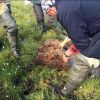
7,000 underground gas bubbles poised to 'explode' in Arctic
Scientists have discovered as many as 7,000 gas-filled 'bubbles' expected to explode in Actic regions of Siberia after an exercise involving field expeditions and satellite surveillance, TASS reported. A number of large craters - seen on our images here - have appeared on the landscape in northern Siberia in recent years and they are being carefully studied by scientists who believe they were formed when pingos exploded.
-
 +20 +1
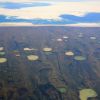
Massive permafrost thaw documented in Canada, portends huge carbon release
Huge slabs of Arctic permafrost in northwest Canada are slumping and disintegrating, sending large amounts of carbon-rich mud and silt into streams and rivers. A new study that analyzed nearly a half-million square miles in northwest Canada found that this permafrost decay is affecting 52,000 square miles of that vast stretch of earth—an expanse the size of Alabama.
-
 +7 +1
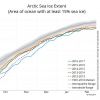
+7 +1Global Sea Ice at Record Low: What Happens When All the Ice Melts?
The Arctic continues to be short on ice, compared to average, in this final month of meteorological winter.
-
 +13 +1
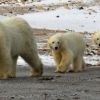
Polar Bear Cubs at High Risk from Toxic Industrial Chemicals, Despite Bans
Levels in young animals elevated to 1,000 times the acceptable amount in people. By Deirdre Lockwood.
-
 +17 +1
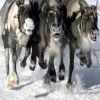
Anthrax in the Arctic
Why wolves are the least of a reindeer’s worries this Christmas. By India Bourke.
-
 +4 +1
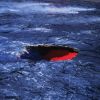
+4 +1Molten iron river discovered speeding beneath Russia and Canada
The magma stream should help geophysicists predict more accurately if and when the magnetic field of the planet’s core will flip, and the magnetic north and south poles trade places, which happens every few thousand years. By Andy Coghlan.
-
 +24 +1
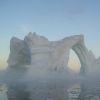
Arctic Is Warming At ‘Astonishing’ Rates, Researchers Say
Scientists meeting in San Francisco issue their 2016 report card. By Christopher Joyce.
-
 +27 +1
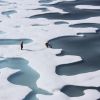
The Arctic is experiencing such extreme climate change it could end up above freezing
The Arctic archipelago of Svalbard has seen such extreme warmth this year that the average annual temperature could end up above freezing for the first time on record, scientists have said. Ketil Isaksen of the Norwegian Meterological Institute said that the average temperature in Longyearbyen, the main settlement in Svalbard, is expected to be around 0 Celsius (32 Fahrenheit) with a little over a month left of the year. "This is a little bit shocking," Isaksen said. "If you had asked me five or 10 years ago, I could not have imagined such numbers in 2016."
-
 +30 +1
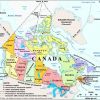
The giant flaw in Canadian maps you never noticed: Mapmakers keep pretending we own the North Pole
It’s a mistake seen in the maps issued by Elections Canada, the National Research Council and the Canadian Armed Forces. It’s even in the official Atlas of Canada and on hundreds of relief maps hung up in schoolrooms across the country. For nearly 100 years, the government of Canada has been printing official maps incorrectly pretending that it owns a U.K.-sized chunk of international waters. “There’s no such thing as having a border hundreds of miles from your territorial lands,” says Heather Exner-Pirot, managing editor of the peer-reviewed Arctic Yearbook.
-
 +21 +1
A Mysterious 'Ping' Is Coming from Deep in the Arctic
A mysterious noise emanating from the sea floor in one of Canada’s northern territories has been puzzling locals and officials, who have yet to identify its source. The sound has been heard throughout Fury and Hecla strait, a channel of water in the Nunavut region, and has proven to be a mystery for the local community. The remote area is located in the northernmost territory of Canada, where some residents rely on hunting for their food supplies.
-
 +20 +1
The Canadian Military Is Investigating a Mysterious Noise In the Arctic
In the tiny Arctic hamlet of Igloolik, Nunavut, hunters say a mysterious sound, seemingly coming from the bottom of the sea, is driving wildlife away. According to the CBC, locals have different theories about its source, and have attributed this “ping” or “hum” to a mining company that has operated nearby, or even to sabotage by Greenpeace. Both entities denied having anything to do with the phenomenon that hunters allege has made an area once teeming with wildlife a bit more barren over the course of the summer.
-
 +29 +1
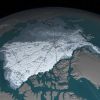
Watch 30 Years of Arctic ice shrinkage in chilling NASA timelapse
A new animation from NASA shows the movement of Arctic sea ice, the large mass of frozen water on the Arctic Ocean, in a stunning time-lapse spanning three decades.
-
 +20 +1
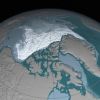
Older Arctic Sea Ice Disappearing
Arctic sea ice has not only been shrinking in surface area in recent years, it’s becoming younger and thinner as well. In this animation, where the ice cover almost looks gelatinous as it pulses through the seasons, cryospheric scientist Dr. Walt Meier of NASA Goddard Space Flight Center describes how the sea ice has undergone fundamental changes during the era of satellite measurements.
1 comments by rti9 -
 +5 +1
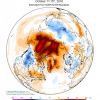
+5 +1Sea Ice Extent Is Near Record Lows–South as Well as North
Sea ice is at a record-low extent for late October in the Arctic and close to a record low in the Antarctic. The latter is a big change from unusually high extents in recent years. The global total of sea ice (Arctic plus Antarctic] is more than 1 million square kilometers below the previous record for late October.
-
 +25 +1
ARCTIC - Visual Vibes
-
 +37 +1
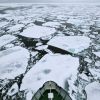
Arctic Ocean Shipping Routes 'to Open for Months'
Shipping routes across the Arctic are going to open up significantly this century even with a best-case reduction in CO2 emissions, a new study suggests.
-
 +18 +1
The End of the Arctic
-
 +5 +1
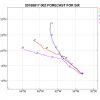
+5 +1The Great Arctic Cyclone of 2016: After Four Years, a Summer Sequel
As of Tuesday, the deepest cyclone in the Northern Hemisphere wasn’t anywhere near the tropics--it was spinning in the central Arctic Ocean. A surface low located near 83°N, about 500 miles from the North Pole and about 1000 miles north of Barrow, Alaska, deepened to a central pressure of 968 mb at 2 am EDT Tuesday morning, August 16. This is on par with the central pressure you might find in a moderately-sized Category 2 hurricane. The low harks back to the Great Arctic Cyclone of 2012.
-
 +36 +1
The Arctic could become ice-free for first time in more than 100,000 years
The Arctic is on track to be free of sea ice this year or next for the first time in more than 100,000 years, a leading scientist has claimed. Provisional satellite data produced by the US National Snow & Ice Data Centre shows there were just over 11.1 million square kilometres of sea ice on 1 June this year, compared to the average for the last 30 years of nearly 12.7 million square kilometres. This difference – more than 1.5 million square kilometres – is about the same size as about six United Kingdoms.
Submit a link
Start a discussion